
The Africa Network for Environment and Economic Justice (ANEEJ) the foremost enviromental justice and anti-corruption crusader in Nigeria has shared its achievements in 2025 as the year runs out.
In a comprehensive document detailing the achievements in different thematic pillars, the Executive Director of ANEEJ, who signed the document that the achievements were made possible as result of the shared commitment of its partners, citizen engagement, evidence-based advocacy, and high-level policy engagement at national, regional, and global levels.
“As 2025 draws to a close, the Africa Network for Environment and Economic Justice (ANEEJ) is pleased to share highlights of our collective achievements this year across key thematic areas. These stories reflect our commitment to advancing anti-corruption, asset recovery, social protection, environmental justice, prevention of organised crime, and transparency reforms, made possible through robust partnerships, citizen engagement, evidence-based advocacy, and high-level policy engagement at national, regional, and global levels, ensuring that governance reforms translate into real benefits for citizens.
Anti-Corruption and Asset Recovery: From National Advocacy to Global Platforms
“In 2025, ANEEJ significantly strengthened Nigeria’s civil society presence in global and national anti-corruption spaces. A major milestone was ANEEJ’s participation in the 11th Conference of States Parties (CoSP11) to the United Nations Convention Against Corruption (UNCAC) in Doha, Qatar. At CoSP11, ANEEJ contributed to high-level deliberations on asset recovery, beneficial ownership transparency, and international cooperation, while amplifying civil society demands for the transparent, accountable, and development-focused use of returned assets.
“Exit from the FATF Grey List
“In October 2025 Nigeria achieved a major anti-corruption and financial integrity milestone with its official removal from the Financial Action Task Force (FATF) Grey List, marking the culmination of sustained reforms to strengthen the nation’s Anti-Money Laundering and Counter-Financing of Terrorism (AML/CFT) framework. ANEEJ publicly commended this achievement, highlighting that it reflected “collective will to build a transparent, resilient, and credible financial system” and celebrating the leadership of the Federal Government, the Nigerian Financial Intelligence Unit (NFIU), AML/CFT community, and development partners in meeting global standards. ANEEJ’s strategic advocacy, in partnership with the African Center for Governance, Asset Recovery and Sustainable Development (with support from the UK’s Foreign, Commonwealth & Development Office), helped deepen compliance culture and institutional readiness for the FATF review process by promoting beneficial ownership reforms, sectoral supervision and cross-sectoral dialogue. Nigeria’s delisting is seen as a defining moment that restores international confidence in its financial system, encouraging investor participation and enhancing governance credibility, even as ANEEJ continues to call for sustained implementation of AML/CFT reforms.
“Capacity Building for ARMU, ACAs and Civil Society on Asset Recovery Monitoring
“ANEEJ made significant strides in strengthening institutional and civil society capacity to monitor asset recovery and returned assets utilization under the UK-supported Tackling Illicit Financial Flows (IFFs) through Asset Recovery and Management and Countering Money Laundering/Counter Terrorism Financing/Proliferation Financing (ML/CFT/PF) in Nigeria project. In Bayelsa State, ANEEJ led workshops that brought together CSOs, community groups and media practitioners to build skills for tracking and evaluating how recovered assets are used, including baseline data generation for monitoring health facility improvements funded by restituted funds such as the legacy from the late Diepreye Solomon Peter Alamieyeseigha (approximately $954,807) and broader monitoring frameworks for high-value recovered assets like the $52.8m linked to former Minister Diezani Alison-Madueke. These efforts established the groundwork for systematic, evidence-based civic oversight of asset disposition, ensuring that restitution delivers direct benefits to vulnerable communities and strengthens anti-corruption accountability mechanisms. Local deployment of trained monitors across health facilities supports a baseline assessment model that will track performance and transparency over time.
“Baseline Data Generation and Monitoring for Repatriated Assets
“Building on asset recovery advocacy, ANEEJ facilitated the commencement of baseline data generation exercises in Bayelsa State aimed at establishing a credible monitoring foundation for the utilization of repatriated funds, including the $900,000 linked to the Alamieyeseigha loot and the $52.8m remitted in relation to assets associated with Diezani Alison-Madueke. In November 2025, ANEEJ convened stakeholders to review and validate baseline data for primary health centres that will benefit from these funds. This evidence base will enable community-level tracking of service improvements and public resource impact, fulfilling principles of transparency and accountability central to the Global Forum on Asset Recovery (GFAR). By institutionalising baseline assessments, ANEEJ’s work ensures that returned assets are not only recovered but effectively monitored for public good, providing a model for future returned asset reinvestment across Nigeria.
“At the national level, ANEEJ sustained robust advocacy around the implementation of the Proceeds of Crime (Recovery and Management) Act (POCA) 2022, consistently framing asset recovery as both an anti-corruption and national security imperative. Through policy briefs, press statements, and stakeholder engagements, ANEEJ reinforced the principle that resignation from office cannot substitute investigation, prosecution, and deterrence, particularly in high-profile corruption cases.
“These efforts contributed to deeper public discourse on accountability and strengthened pressure on institutions to operationalise existing legal frameworks rather than rely on discretionary measures.
“In line with SDG 4 and SDG 16, ANEEJ organised a one-day international anti-corruption event in 2025 targeting youth and young people, recognising education and civic awareness as critical foundations for accountable governance. The event equipped young participants with knowledge, advocacy skills, and ethical leadership tools to challenge corruption and promote transparency within their communities. By convening youth leaders, civil society organisations, policy experts, and international partners, the initiative also advanced SDG 17, fostering partnerships that support intergenerational engagement and sustain long-term anti-corruption reforms. The event reaffirmed ANEEJ’s commitment to empowering young people as agents of change in building peaceful, just, and inclusive societies.
“Social Protection: A Landmark Year for Policy and Legislative Wins
“Social protection advocacy under the ActNaija! project reached a historic peak in 2025. One of the most notable success stories was the signing into law of the Delta State Social Investment Programme Law by Governor Sheriff Oborevwori. This landmark legislation institutionalises social investment in Delta State, providing a legal framework for coordination, transparency, and sustainability of social protection interventions.
“ANEEJ’s consistent engagement through policy dialogues, citizen advocacy, and coalition-building played a critical role in sustaining momentum that culminated in this legislative victory. The signing of the law stands as a clear example of how civil society advocacy can translate into enforceable policy outcomes, moving social protection from discretion to obligation.
“ANEEJ also facilitated state-level social protection dialogues in Delta State, Enugu, Kogi and Borno States contributing to:
Legislative momentum for social investment laws.
Greater citizen awareness of social protection entitlements.
“Stronger CSO-government collaboration at sub-national levels.
High-Level Engagement on Social Protection Policy in Kogi State
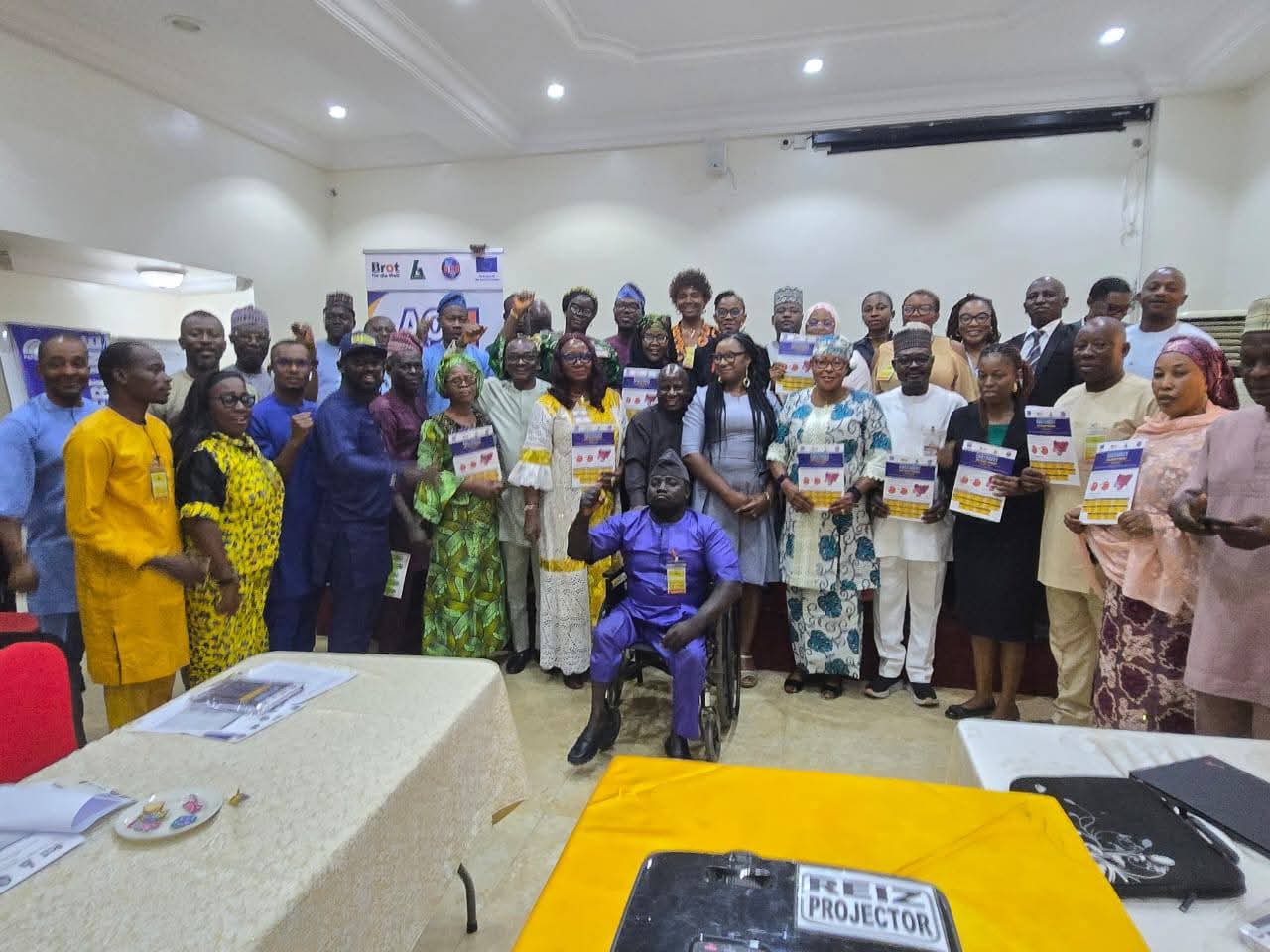
“Under the ActNaija – Civil Society Action to Strengthen Social Protection in Nigeria project (co-funded by the European Union), ANEEJ facilitated high-level engagements that moved social protection policy from concept to consensus, particularly in Kogi State. In December 2025, ANEEJ organised a one-day validation seminar on the draft social protection policy, bringing together the Kogi State House of Assembly, government ministry representatives, development partners and other stakeholders to refine and adopt a policy blueprint that will underpin future legislative action. The Deputy Speaker of the Kogi State House of Assembly emphasised the importance of legalising social protection interventions to safeguard the rights of vulnerable groups, while the ActNaija team supported technical improvements to the draft ahead of its eventual submission to the legislature. This engagement marked a key milestone in collaborative policymaking, demonstrating how civil society and government can work in tandem to frame responsive, legally grounded social protection frameworks at the state level.
“At the national level, ANEEJ deepened engagement with the Federal Ministry of Humanitarian Affairs and Poverty Reduction, the National Social Investment Programme Agency (NSIPA), and development partners. These engagements focused on improving coordination, inclusion, and accountability across social protection programmes.
A major institutional achievement during the year was the launch of the National Working Group on ActNaija, which now serves as a structured platform for continuous dialogue, monitoring, learning, and coordination among civil society, government, and partners. This mechanism ensures that engagement on social protection is sustained, evidence-driven, and nationally coordinated.
“10 Livelihood Project (Supported by Bread for the World, Germany)
With support from Bread for the World, Germany, ANEEJ advanced the 10 Livelihood Projects in 2025, contributing directly to SDG 1 and SDG 10 by addressing poverty, vulnerability, and social exclusion through livelihood-centred advocacy and social protection engagement. The project strengthened community resilience and voice, enabling vulnerable populations to engage governance systems and demand equitable access to social investment and livelihood opportunities. By integrating climate justice and environmental accountability into livelihood discussions, the project also supported SDG 13, while its emphasis on transparency and anti-corruption reinforced SDG 16, linking sustainable livelihoods with accountable institutions and long-term development outcomes.
“Debt Cancellation and International Cooperation
“In 2025, ANEEJ strengthened its long-standing advocacy on debt justice, cancellation, and responsible international cooperation, recognising unsustainable debt as a major constraint to development, social investment, and climate resilience in Nigeria and across Africa. ANEEJ actively participated in high-level international policy dialogues, including the Financing for Development (FfD) Conference in Sevilla, Spain, where it joined global civil society actors in advocating for fair debt restructuring, transparent lending practices, inclusion of victims of corruption in asset return negotiations and increased fiscal space for social protection and climate action. Regionally, ANEEJ participated in the AFRODAD Debt Conference (AFCODD V) in Accra, Ghana, contributing civil society perspectives on Africa’s debt crisis, illicit financial flows, and the need for creditor accountability. At the national level, ANEEJ convened and hosted a National Debt Conference in Abuja, bringing together policymakers, economists, civil society, and development partners to examine Nigeria’s rising debt burden and promote policy options that prioritise debt sustainability, accountability, and people-centred development. Through these engagements, ANEEJ reinforced the link between debt justice, anti-corruption, and inclusive growth, positioning debt cancellation as a critical enabler of national development and social justice
Environmental Justice and Climate Action: Linking Climate, Accountability, and Livelihoods
“ANEEJ continued to advance environmental justice by linking climate action to governance, accountability, and social inclusion. In 2025, ANEEJ participated in advocacy spaces connected to the global climate process, including COPS30, ensuring that the voices of vulnerable communities, particularly in extractive and climate-affected regions remained central to climate discourse.
“Nationally, ANEEJ sustained advocacy on environmental degradation, pollution, and climate-induced vulnerabilities in the Nigeria, emphasising that environmental injustice deepens poverty and undermines social protection outcomes. This integrated approach strengthened the link between climate justice and broader development reforms.
“Prevention of Organised Crime
“In 2025, ANEEJ recorded notable progress under the Brighter Futures Project, supported by the UK Government through the Home Office, which directly advanced SDG 16 by strengthening civil society and institutional responses to corruption, organised crime, and illicit financial flows. Through targeted capacity-building, stakeholder engagement, and policy advocacy, the project improved collaboration among civil society organisations, anti-corruption agencies, and community actors, contributing to stronger accountability frameworks and m. By fostering multi-stakeholder partnerships and cross-sectoral dialogue, the project also reinforced SDG 17, positioning ANEEJ as a strategic partner in building resilient institutions capable of preventing financial crime and promoting sustainable peace and development in Nigeria.
“Prevention of Human Trafficking
“In 2025, ANEEJ advanced its Prevention of Human Trafficking Project, supported by the Global Initiative Against Transnational Organized Crime (GI-TOC), with a strong focus on addressing the structural drivers of human trafficking, including poverty, inequality, weak institutions, and organised criminal networks in Ologbo community, Ikpoba Okha Local Government Area of Edo State. Through research, stakeholder engagement, and community-level awareness activities, the project strengthened understanding of trafficking patterns, recruitment methods, and the links between trafficking, illicit financial flows, and corruption. ANEEJ’s interventions enhanced collaboration among civil society actors, community leaders, and relevant institutions to promote early prevention, victim protection, and accountability. By prioritising prevention and governance reforms alongside awareness, the project contributed to safer migration pathways, reduced vulnerability among at-risk populations, and stronger institutional responses to human trafficking in line with global best practices.
“Rewards and Recognition: Incentivising Transparency through NOCOPO
Under the CASARN project, ANEEJ advanced a positive accountability model by recognising public institutions that demonstrated high levels of compliance with procurement transparency requirements on the Nigeria Open Contracting Portal (NOCOPO).
“Institutions that ranked highest in data publication and procurement disclosure were publicly acknowledged, reinforcing transparency as a standard of excellence rather than a punitive obligation. This recognition helped stimulate increased interest and compliance among MDAs, strengthening Nigeria’s open contracting ecosystem.”
The organisation also shared the link to some of its work that can be assessed online.
“Media Engagement and Public Influence
“ANEEJ’s work in 2025 consistently shaped national discourse through strategic media engagement. Our interventions on asset recovery, FATF compliance, procurement transparency, social protection reforms, and corruption-related accountability featured prominently in national media, ensuring that complex governance issues remained accessible to citizens and decision-makers alike. Here are some interesting links:
“ANEEJ launches policy framework to strengthen asset recovery in Nigeria
7 states to benefit from ‘Act Naija’ social devt initiative
ANEEJ, African Center Secure Commitment from Government, Other Stakeholders to Deliver on the Illicit Finance Resilience Project
Delta State CSOs Call for Stronger Asset Recovery Framework, Urge Lawyers to Deepen Knowledge of Money Laundering Laws
ANEEJ Commends Nigeria’s Exit from FATF Grey List, Celebrates Collective Reform Success and Government Leadership– Calls for Sustained Vigilance, Coordination, and Inclusive Reform Implementation
Ugolor Advocates Stronger Implementation of POCA on NTA’s Good Morning Nigeria
ANEEJ Secures Commitment with BPP to Advance Procurement Reforms in Nigeria
ANEEJ, NSIPA Strengthen Collaboration on Social Protection Monitoring Through ActNaija Project
ANEEJ Urges States to Adopt a Human-Centred Approach to Migration, Prioritise Protection of Vulnerable Women and Children
Kogi Assembly partners ACT NAIJA, ANEEJ to domesticate social protection law”
2025 International Anticorruption Day Event
AUABC Appoints Ugolor To Non-State Actors Forum Interim Executive Council
ANEEJ Welcomes the United Kingdom’s 2026 Anti-Corruption Strategy, Calls for Deepened Collaboration with the Global South
ANEEJ Calls for Sustained Independent Investigation Following Resignation of NMDPRA Chief Executive
ANEEJ Congratulates Governor Oborevwori, Delta Assembly on Assent to Delta State Social Investment Programme Law
ANEEJ Trains CSOs in Bayelsa State to Monitor Recovered Asset Utilization in Primary Health Care
Here are some insightful discussions on National TV
ENGAGEMENT MEETING WITH MINISTER OF STATE FOR MINISTRY OF HUMANITARIAN AFFAIRS AND POVERTY REDUCTION, DR. YUSUF TANKO SUNUNU
Ugolor Speaks on Uniting Nigeria’s Youth Against Corruption
Redefining Nigeria’s Social Protection System
If Human Rights Are Not Respected, Nigeria Will Face Major Challenges – David Ugolor
Tackling Illicit Financial Flows
Our TV discussion series, Governance and Development Conversation, continues to provide a platform for informed dialogue on governance and development issues. Engage with the episodes
Information that may excite you about what we do
Bracing up to another phase of the Ogoni Struggle
Why Financial Giants Should Stop Bankrolling Climate Catastrophe
Drumming Support for the NEAT Initiative in Nigeria
Celebrating International Women’s Day 2025: Accelerating Action for Women and Children’s Education in Nigeria
Reinvigorating the Fight against Corruption in Nigeria
Confronting Child Abuse in Our Society
Police/Law Enforcement and the Political Elites: A Threat to Civil Society Leaders.”