
By Lucky Isibor
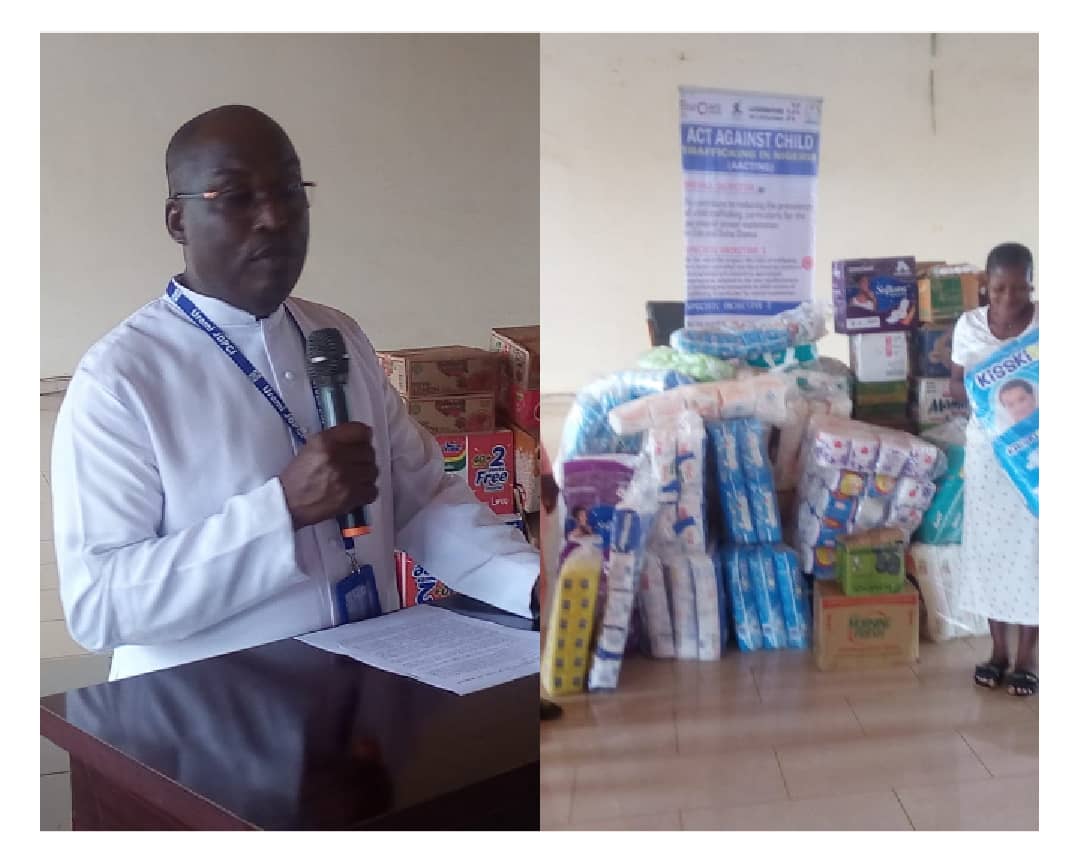
As part of its efforts to stem the incidence of irregular migration, the Uromi Justice Development, Peace and Caritas Initiatives (Uromi JDPCI) on Tuesday, 10 February empowered three young female returnee migrants and victims of human trafficking with business starter packs to facilitate their reintegration into the society, be gainfully employed and prevent them from being re-trafficked.
In his remarks at the event which which was part of activities to mark the 12th International Day of Prayer and Awareness Against Human Trafficking celebrated on the Feast of Saint Josephine Bakhita, the Patron Saint of victims and survivors of human trafficking and Uromi JDPCI Fourth Consultation Mechanism Meeting of Community and Institutional Justice Actors on child trafficking; the Executive Director of Uromi JDPCI, Very Rev. Fr. Fidelis Arhedo pointed out that the life of Saint Josephine Bakhita is a testimony that dignity can be restored even after severe abuse, and her story challenges us to work tirelessly for the freedom and dignity of every human person.
Dwelling on the theme for this year’s observance, “Peace begins with dignity: a global call to end human trafficking,” Fr. Arhedo noted that the theme reminds us that peace cannot exist where human dignity is violated adding that a society that condones exploitation, abuse and dehumanisation cannot experience true peace.
While emphasising that human trafficking is an assault on human dignity, Fr. Arhedo disclosed that “Today, an estimated 50 million people are living in conditions of modern slavery, including sexual exploitation, forced labour, child marriage, domestic servitude, drug trafficking, and organ harvesting. Many victims are lured by false promises of employment, education, marriage, or overseas travel. Increasingly, traffickers operate online, using social media and digital platforms to prey on children and young people who are searching for opportunities and a better future.
“Human trafficking is a grave assault on human dignity. It strips victims of freedom, identity, and choice, reducing them to instruments of profit. Survivors often endure profound physical, emotional, and psychological trauma. Many live with deep fear, shame, broken self-worth, injuries, disabilities, and long-term health complications. Some suffer sexual and reproductive health problems, including sexually transmitted infections, unwanted pregnancies, unsafe abortions, drug addiction, prolonged detention, and in tragic cases, death. These wounds do not end when exploitation ends; they linger long after.
“As we reflect on these painful realities, we join St. Josephine Bakhita today in prayer for all victims and survivors of human trafficking. We pray for their healing, restoration, and access to justice, as well as the strength of their families. We also pray for the conversion of the hearts of traffickers and exploiters, that they may turn away from violence, greed, and cruelty. Above all, we pray that our society may find the courage to break the silence and dismantle the structures, attitudes, and systems that allow exploitation to flourish.”
The Uromi JDPCI also called on protection actors, community leaders, traditional rulers and parents to stand together as a protective shield to create safe environments where concerns can be raised without fear, suspicious activities are questioned and cases of trafficking or exploitation can be promptly reported and addressed.
“Beyond prayer and reflection, this day calls us to action.
Parents have a critical responsibility to protect their children. They must provide care, education, guidance, and emotional support, ensuring that the home remains a safe and nurturing environment, not a place of violence or neglect from which children feel compelled to escape. Parents should never push or indirectly encourage children into risky journeys or exploitative situations in the hope of economic gain. Children are not a solution to family poverty; no child should ever be treated as a sacrifice for survival.
“Children and young people also have a role to play.
They must focus on education and skills acquisition as secure paths to a dignified future, and resist the temptation of quick money or dangerous shortcuts. They should be cautious of offers that sound too good to be true, practice safe online behaviour, ask questions, resist pressure, and seek guidance from trusted adults, parents, teachers, faith leaders, or child-protection actors whenever something feels wrong.”
During the dialogue session, participants and stakeholders emphasised the need for intensified sensitisation in rural communities on the criminal nature of child exploitation, particularly involving underage children sent to households as domestic helpers. They noted that many caregivers and households were either unaware or insufficiently informed that abusing, neglecting, or exploiting such children constitute child trafficking offence. This lack of awareness often resulted in harsh treatment, neglect and the denial of basic care and dignity to affected children.
Participants also lamented lack of cooperation from parents and guardians of victims of rape and child trafficking during prosecution of offenders, hence called for more sensitisation at community levels to boost awareness.
The beneficiaries of the empowerment included Sarah Chukwuemeka, Favour Abamenoje and Afiamen Wisdom and were empowered with goods and equipment worth over one million naira each, along with one year store rentage.
Favour Abamenoje and Afiamen Wisdom, were empowered with goods and equipment to establish a “Provision Store” and to set up “Mother Care Shop” respectively; while Sarah Chukwuemeka was assisted to set up tailoring and fashion home.