
By Lucky Isibor
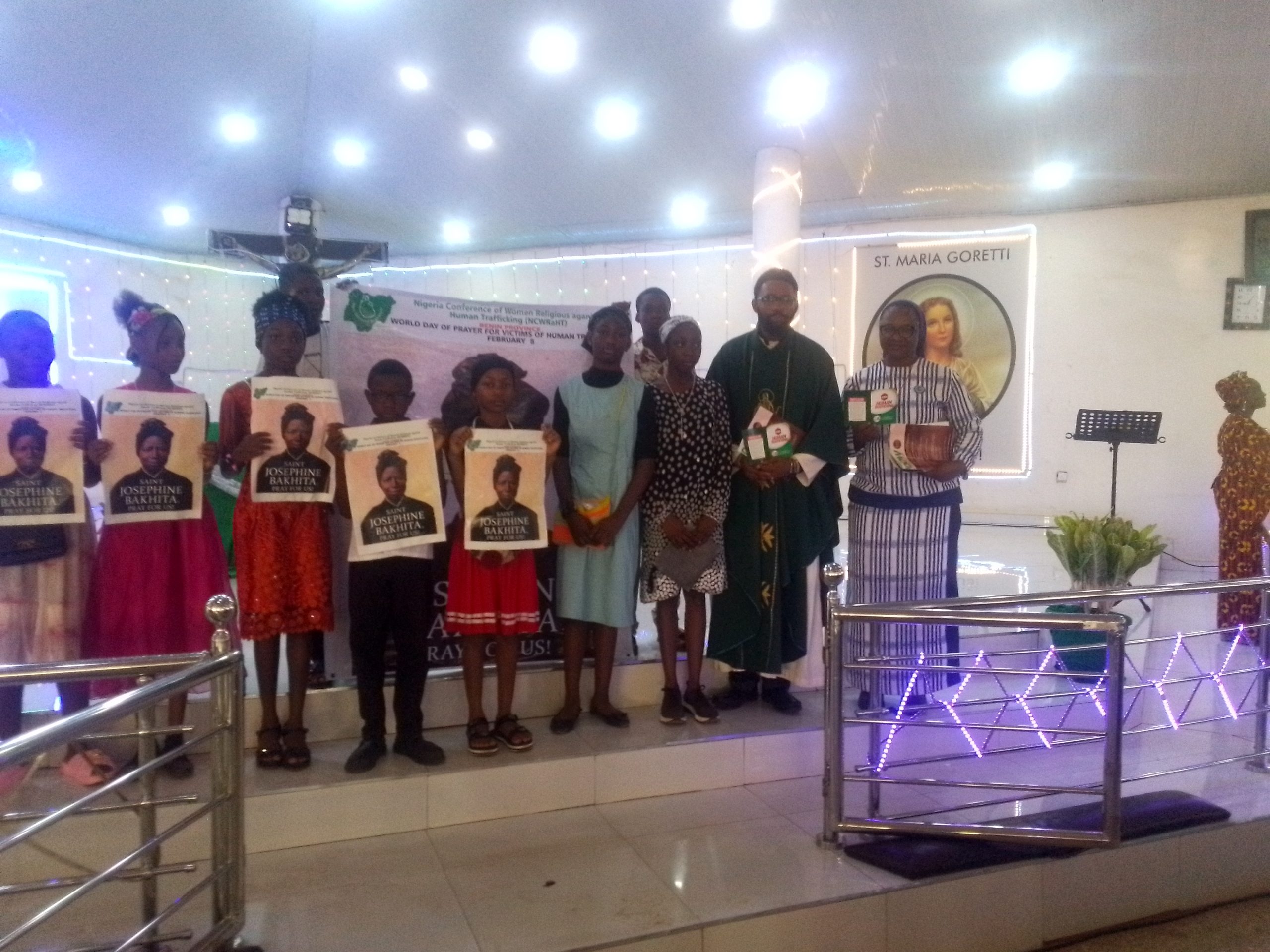
Reverend Sisters of the Sacred Heart of Jesus has taken the campaign against human trafficking to Catholic Churches in the Archdiocese of Benin City with a view to enlightening young people, parents and members of the public on the dangers of human trafficking and irregular migration.
Speaking at St. Maria Goretti Catholic Church in the Upper Sokponba area of Benin City, Rev. Sis. Anthonia Okoroafor appealed to young adolescents, parents and guardians to beware of traffickers who go about promising juicy employments in Europe and other continents of the World, pointing out that they’re not real, but ploys to lure them into being trafficked into modern day slavery.
Sis. Okoroafor who said that herself and other Reverend Sisters of the Sacred Heart work for “Fullness of Life Counselling and Development Initiative,” a Non-Governmental Organisation (NGO) pointed out that the organisation takes care of victims of human trafficking, abused children and abused persons generally.
While encouraging survivors to come up for assistance to learn skills that will empower them, Sister Okoroafor said the enghlightenment visits to various parishes in Benin City is part of activities to mark the 12th International Day of Prayer and Awareness Against Human Trafficking celebrated on the Feast of Saint Josephine Bakhita, the Patron Saint of victims and survivors of human trafficking held annually on 8 February.
She disclosed that Josephine Bakhita was a Sudanese young girl child who was sold to some Arabians as slave,
endured immense suffering, and later regained her freedom in Italy, got converted to the Catholic faith and eventually became a Reverend Sister till her death in 1945, and urged victims not to loose hope.
While enumerating the works of the “Fullness of Life Counselling and Development Initiative,” Sis. Okoroafor said, “In this NGO we take care of victims of human trafficking, we also taking care of abused children, abused persons.
“And when it comes to victims of human trafficking we render psychosocial support to these victims, when they come to us, or sometimes they call us that there are victims, we go to them, get them and try to rehabilitate them. We also help in the reintegration of these victims, we refer them to shelters where they can be rehabilitated like NAPTIP and others. We also empower them by teaching them skills and establishing some trades for them like recently. There are some we’re monitoring, we train them in skills such as hair dressing. Some of them are doing that now, two young girls and another one who opened their shops in Sokponba Road area in Benin City. We source for funds and when we are given, we use these funds to establish the victims we’re rehabilitating. We also have another one who learnt bakery, right now she got a shop through the funds we sourced, she’s baking now and she is doing very well. A fews days ago, we went round to monitor them to ascertain what they’re going through, and they are doing very well.
“We also teach them financial management so that they’ll be able to record their businesses well and ensure that these their businesses are sustainable, should be able to take care of themselves optimaly, because we noticed that the poverty margin is just great and somehow it forces people into this kind of slavery, some, not all though; for some it’s greed. However, these are all problematic and so we try to help them.”
While urging parents to monitor their children, make them acquire skills if they cannot go to school, Sis. Okoroafor noted that, “There are so many dangers, you have some effects, it enslaves them, it makes them slaves, they’re no longer free, they mete out inhuman treatment to them. Some of these victims go mad because of these ill-treatment, some even die in the process; some are killed and their organs harvested, some of them forced into prostitution, some contact HIV in the process and some die of sexually transmitted diseases and all of that.
“My advice to the young ones and parents is firstly, they should trust God, secondly there is dignity in labour; they should try to work hard, hard work still pays. The parents should try to look after their children, monitor their children, know their whereabouts, train them, help them to acquire skills, if they cannot go to school let them acquire skills so that they grow up having focus and become responsible to their families, themselves and the society.”