
By Lucky Isibor
The Uromi Justice Development and Peace Caritas Initiative JDPCI, a human rights initiative of the Catholic Diocese of Uromi has intervened in over 300 cases of human rights violations in Edo Central Senatorial District in the last one. The organisation also carried out 74 non-case-based interventions through advocacy visits, sensitisation campaigns and provided over 320 support services, including psychosocial counselling, referrals and application of Alternative Dispute Resolution (ADR) mechanism.
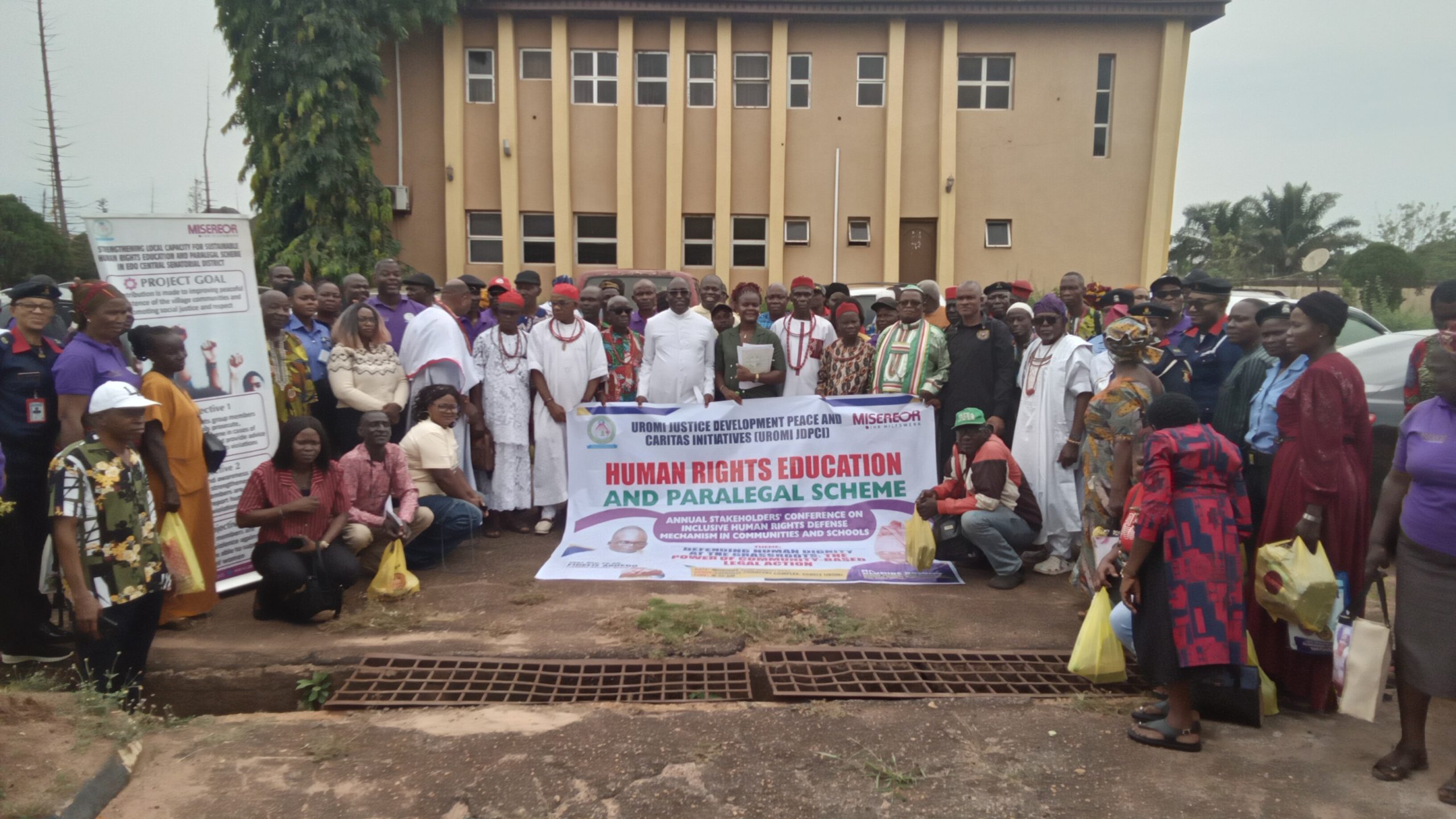
This was disclosed by the Executive Director of Uromi JDPCI, Very Rev Fr Dr. Fidelis Arhedo in his keynote address at the opening of the Human Rights Education Paralegal Scheme Project Annual Stakeholders’ Conference and Coordination Meeting on Inclusive Human Rights Defence Mechanism, held on Thursday, 26 March at the Uromi Catholic Diocesean Chancery, Uromi.
Harping on the theme of this year’s conference which is, “Defending Human Rights at the Grassroots: The Power of Community-Based Legal Action,” Fr. Arhedo pointed out that human rights violations are going on daily in the various communities and called for collaborative efforts from the stakeholders to check the menace.
“In our communities, human rights violations are not abstract concepts; they are daily lived experiences, especially for the poor and the vulnerable. These violations manifest in domestic violence, child abuse, denial of education, harmful widowhood practices, human trafficking, arbitrary detention, and other infringements on fundamental freedoms.
“From the perspective of Catholic Social Teaching, such realities contradict the fundamental principle of the inviolable dignity of the human person, created in the image and likeness of God.
“Within the past year, across the five Local Government Areas of Edo Central Senatorial District, our community-based human rights structures intervened in over 300 documented cases of human rights violations. These included: 87 cases of domestic violence, 58 cases of neglect and abandonment, 28 cases of assault, 20 cases of rape, 16 cases of child labour and trafficking.
“Alongside other violations such as denial of education, harmful widowhood practices, and arbitrary detention In addition, 74 non-case-based interventions were carried out through advocacy visits and sensitisation campaigns, while over 320 support services were provided, including psychosocial counselling, referrals, and the application of Alternative Dispute Resolution mechanisms.
“These figures are not mere statistics; they represent human faces, human pain, and human stories. Yet, beyond the pain, they also reveal a deeper narrative, a narrative of transformation and hope.
“In the past, many of these cases would have remained hidden under the weight of fear, stigma, and cultural silence. Today, we are witnessing a gradual awakening. Communities are finding their voice. Survivors are stepping forward. Local actors are assuming responsibility.
“Indeed, over 434 cases have been resolved at the community level, indicating growing trust in grassroots justice mechanisms. This reflects what the Catholic Social Teaching describes as the principle of subsidiarity, where issues are addressed at the most immediate level capable of resolving them effectively.”
While calling for collaborative efforts, Fr. Arhedo pointed out that the achievements enumerated were not accidental, but the result of intentional and sustained investment in community based legal action, adding that over 2,200 persons have been trained as human rights actors in the five local government areas of Edo Central Senatorial District.
“This progress is not accidental; it is the fruit of intentional and sustained investment in community based legal action. Over 2,200 individuals have been trained as human rights actors. More than 2,300 adolescents are actively engaged through Human Rights Clubs Over 4,000 women and girls have received support in responding to violence and inequality
“At the heart of this intervention are our community paralegals, ordinary citizens performing extraordinary acts of justice. They embody what Pope Francis describes as a “culture of encounter,” where individuals become agents of compassion, justice, and social transformation.
“They listen to the unheard, accompany the wounded, document injustices, mediate conflicts, and facilitate access to formal justice systems when necessary. In them, we see the living expression of solidarity, a firm and persevering commitment to the good of all, especially the most vulnerable.
“However, experience has taught us that community action alone is insufficient. Grassroots mechanisms can only be effective when they are strongly linked with formal institutions.
“This is why this conference is crucial. It provides an opportunity to: Strengthen coordination and referral pathways, Share practical experiences and best practices;
Address systemic challenges, Build trust between communities and institutions.
“Encouragingly, our coordination platforms have begun to yield positive results. We are witnessing: Increased collaboration among law enforcement agencies, Greater responsiveness from social welfare institutions; Reform-oriented engagement by traditional leaders, Improved case referrals through appropriate channels.”
On the way forward, Fr. Arhedo appealed for collaboration among stakeholders, including law enforcement agencies, traditional leaders civil society actors, legal practitioners and paralegals.
“The way forward lies in strengthened collaboration and renewed commitment: To law enforcement agencies: Your responsiveness builds public trust and strengthens justice. To traditional and community leaders: Your influence shapes norms and cultural transformation. To legal practitioners: Your expertise safeguards the rule of law.
To civil society actors: Your advocacy sustains momentum for change. To our paralegals: You remain the indispensable bridge between communities and institutions.
“We must continue to strengthen referral systems, deepen capacity, and foster partnerships so that no victim is left unheard and no case is neglected.”
While enumerating the various human rights interventions by the paralegals in the five Local Government Areas in Edo Central, the Programme Manager of Uromi JDPCI, Dr. Micheal Iyioribhe appreciated traditional rulers in Esan for their buy-in into the protection of human rights in the district. He disclosed that the traditional rulers have on their own referred some cases of human rights abuses in their community to Uromi JDPCI to handle when they discover that they’re criminal in nature and cannot be handled traditionally without breaching the law.
The Programme Manager also commended the police for their cooperation and collaboration in the protection of human rights and bringing violators to justice.
“Someone referenced a young lady that wanted to kill herself.
“That case was actually reported by a traditional ruler, he reported that case by himself.
And we can tell you that we have gotten like three different cases directly by two traditional rulers. And that means that they are taking it seriously and no longer sleeping over it.
“To think that it’s something we can sit on.So when we want to also blame them, let us remember that it is not easy. We will get there if we take the right step, one after the other.
“I can tell you that most of the cases that we have handled too, they come from the police. They will just come to say, ah, come with this case, I need to come take him. You can imagine the police being so honest and so. But sometimes when you see the very few one, it’s difficult for you to not just say all of them are bad. So in that case we must appreciate those little efforts. Police are doing marvelously well and we can’t take that away. That’s why we are collaborating still with you.”
Collaborating Dr. Iyioriobhe on efforts being made by traditional rulers in the protection of human rights in the area, an Igueben High Chief, Chief Hillary Ekhoye, who represented the Onojie of Igueben, Zaiki Eiluojierior, pointed out that all cases reported to the Onojie of Igueben that have elements of criminality in them are referred to the police to handle, while the palace keeps monitoring the process to ensure it’s not swept under the carpet and justice is done.
In his remarks, the representative of the Police Area Commander in Uromi CSP Osemwengie Osas, pointed out that the police has always cooperated with the Uromi JDPCI in its efforts to protect human rights and assured that the police will continue to cooperate with stakeholders in the protection of human rights and prosecution of violators.
The Coordinator of the Edo State National Human Rights Commission (NHRC), Dr. Olumide Dosumun, who was represented by Mrs. Laureatta Omorogbe, assured that the Commission will always assist stakeholders and communities to work together to protect human rights and bring violators to face the wrought of the law, noting that the law has become a powerful tool for justice and people’s everyday life, adding that human rights violations persists because people do not know their rights.
“Many violations persist simply because people do not know their rights. Knowledge is a first line of defense.
When people understand their constitutional rights and how to repulse violations, they are empowered to challenge injustice and seek redress.”
While commending Uromi JDPCI for empowering its paralegals with the requisite knowledge and capacity that has made them become the bridge between the law and the people, Mrs. Omorogbe sued for community collaboration in protecting human rights at the grassroots and urged security agencies to see paralegals as partners in the nation’s justice system.
“Your paralegal supports communities and the bridge between the law and the people. They are the first responders for justice, advising victims, mediating disputes and referring critical cases. To the paralegals here today, you are the strong heroes. You are the allies and peers of justice.
“When communities organize, they can demand accountability. It’s not an individual coming to the court. When the community joins together and drafts the petition, it’s stronger. So if we collaborate, I’m sure we’ll do things. This could be through petitions engaging with local authorities on public awareness and peace. Such actions strengthen democracy.
“The role of every stakeholder defending human dignity requires all of us to play our part. To the security agencies, police, DSS, NSCDC, I urge you to see those paralegals and advocates not as our persons but as partners in the Nigeria justice system.”
Representatives of traditional rulers, traditional leaders, representatives of the Christian community, Muslim community, traditional religious practitioners, social welfare officers in the five local government areas in Edo Central Senatorial District and other stakeholders attended the meeting.