
By Lucky Isibor
The Uromi Justice, Development, Peace and Caritas Initiative (JDPCI) has called for stronger collaboration among stakeholders to eradicate child labour, abuse, trafficking and exploitation, while promoting the rights and welfare of children across communities.
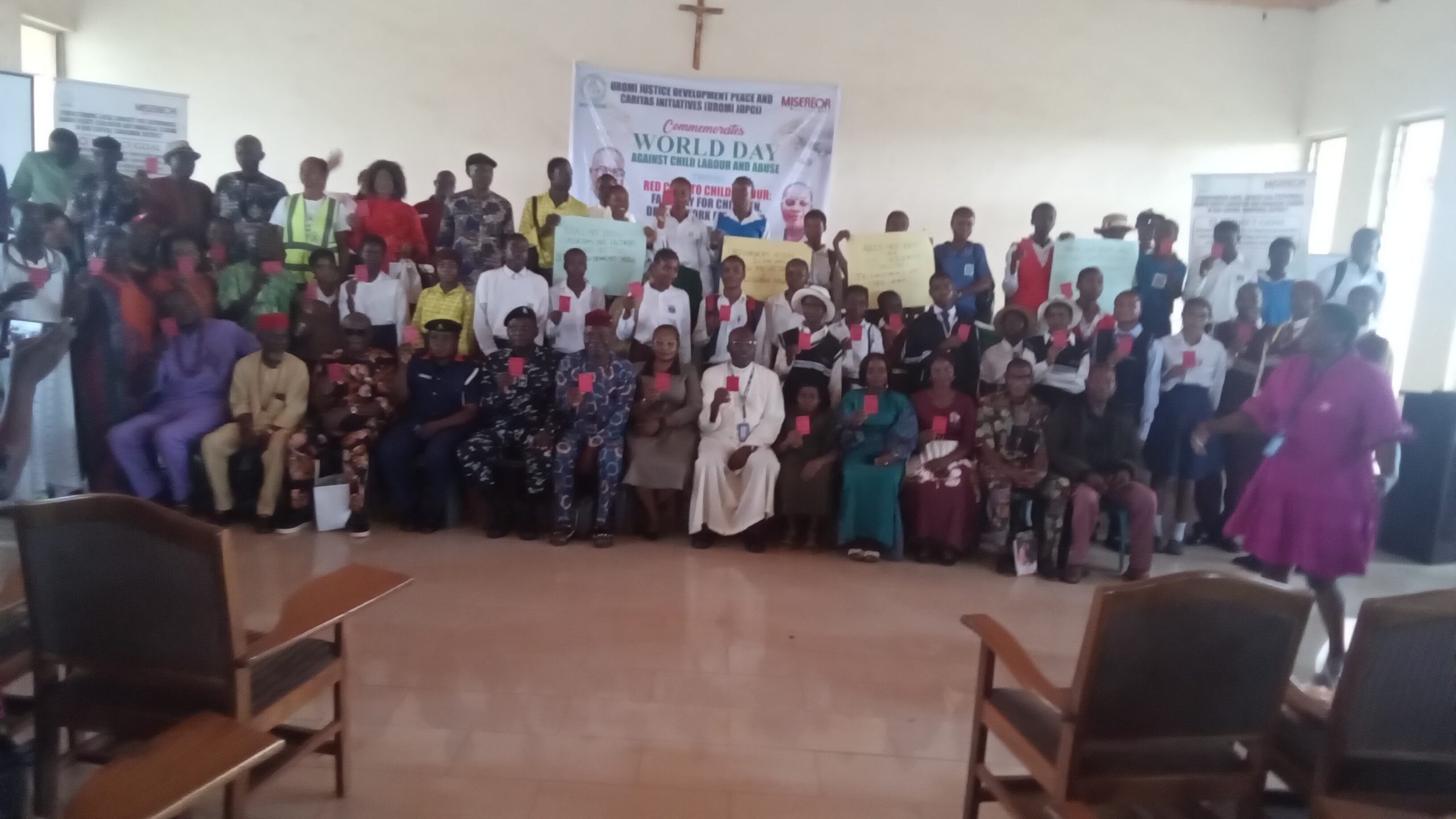
The call was made during the commemoration of the 2026 World Day Against Child Labour and Abuse organised by the Uromi JDPCI under its Human Rights Education and Paralegal Scheme in Edo Central Senatorial District with the support of MISEREOR Germany.
Speaking at the event, the Executive Director of Uromi JDPCI, Very Rev. Fr. Dr. Fidelis Arhedo, said the global observance provided an opportunity to draw attention to the plight of millions of children whose rights, education, health and future are threatened by child labour, abuse, neglect, exploitation and trafficking.
According to him, the theme of the celebration, “Red Card to Child Labour: Fair Play for Children, Decent Work for Adults,” conveys a strong message that society must reject every form of child labour and abuse.
“In sports, a red card signifies conduct that is unacceptable and must stop immediately. In the same way, we are called today to reject every form of child labour and abuse that deprives children of their childhood, education, dignity and opportunity to achieve their God-given potential,” he said.
Fr. Arhedo stressed that fair play for children means creating an environment where every child is free to learn, play, grow and flourish.
“It means ensuring that children carry books rather than burdens, sit in classrooms rather than hazardous workplaces, and pursue dreams rather than struggle under the weight of exploitation and poverty,” he stated.
The cleric further noted that the fight against child labour must go beyond rescuing children from exploitative situations.
“The second part of the theme, ‘Decent Work for Adults,’ reminds us that child labour is often rooted in poverty, unemployment, inequality and lack of social protection. When parents and caregivers are unable to secure decent livelihoods, children frequently become victims of economic hardship.
“Therefore, addressing child labour requires not only rescuing children from exploitative situations but also empowering families through sustainable livelihoods, fair wages and economic opportunities.”
Fr. Arhedo emphasised that protecting children is a shared responsibility involving parents, teachers, government agencies, law enforcement institutions, faith-based organisations, traditional rulers, civil society groups, communities and the media.
He urged stakeholders to move beyond awareness campaigns and take practical steps by identifying children at risk, supporting vulnerable households, enforcing child protection laws and promoting school retention.
“As we gather here, let us raise a collective red card against every form of child labour, child abuse, child trafficking, exploitation, neglect and violence. Let us commit ourselves to building communities where children are safe, educated, respected and empowered to become responsible citizens and future leaders,” he said.
Delivering the keynote address titled “Child Rights and Abuse,” the Child Safeguarding/Gender Based Violence Officer of the Edo State Universal Basic Education Board (SUBEB), Dr. Mrs. Isoken Osemwengie, described a child as any person below the age of 18 years and stressed that society must protect children and uphold their rights.
“A child is any person below the age of eighteen years. When a child is under 18, it means that the responsibility of that child falls on the parents, the guardians or the caregiver in ensuring the well-being of that child,” she explained.
She noted that children are entitled to rights guaranteed under the Child Rights Act 2003 and should not be denied those rights.
“These are protections a child is entitled to. The child gets it. It is the right of that child,” she said.
Dr. Osemwengie highlighted several rights of children, including the rights to life, healthcare, development, protection and participation.
“A child has the right to live. You don’t say because you are an adult that you have the right to truncate or take the life of a child. The child cannot fight back. It is me and you that will protect the rights of these children,” she said.
She also warned against neglect and abandonment of children by parents and caregivers.
“Parents can just abandon children at home to come wherever they like. They don’t care what these children will eat. They don’t even care when they are sick. It is against the Child Rights Act,” she stated.
The SUBEB official underscored the importance of community involvement in child protection, describing communities as critical stakeholders in safeguarding children.
“If you want to do a holistic child protection structure, the community is one major stakeholder that you should hold very strong. If you get the community right, these children will always be safe,” she said.
She expressed concern over reported cases of children being abused on their way to and from school and called on community leaders to promote behavioural change and ensure children’s safety.
Also speaking, the representative of the Onojie of Uromi, Chief Richard Osemeilu, commended the organisers for focusing on children’s welfare and education.
He lamented the growing number of children roaming the streets and dismissed the notion that education is a scam.
“Education is not a scam. Because in whatever you do, if you are not educated, you are uneducated, and that will make you do whatever you are supposed to do in the wrong way,” he said.
Similarly, the representative of the Christian Association of Nigeria (CAN), Pastor Odesanmi, condemned child labour, assuring that the church would continue to sensitise congregations on the dangers of the practice.
“Child labour is an evil, and the church will not condone it. We will continue to tell the congregations about this evil and extend the message that child labour should be given a red card in our families and everywhere,” he said.
A major highlight of the event was a quiz competition on child rights and protection issues involving students from secondary schools across Edo Central Senatorial District.
The competition was won by the representative of Amede-Egoro Secondary School, Amede-Egoro, who also delivered a brief presentation on the topic, “My Rights Against Abuse.”
At the end of the competition, the winner received a cash prize of N50,000, while the first and second runners-up received N30,000 and N20,000 respectively. The students were also presented with school bags and exercise books as part of efforts to encourage learning and deepen awareness of child rights.
Participants at the event pledged renewed commitment to protecting children and supporting initiatives aimed at eliminating child labour and abuse in Edo Central and beyond.