
By Lucky Isibor
Civil society groups in Edo State have called on the Federal Government to make public the concession agreement for the Benin-Asaba road project, citing concerns over poor road conditions, transparency and uncertainty surrounding the ownership and financing of the ₦228 billion project.
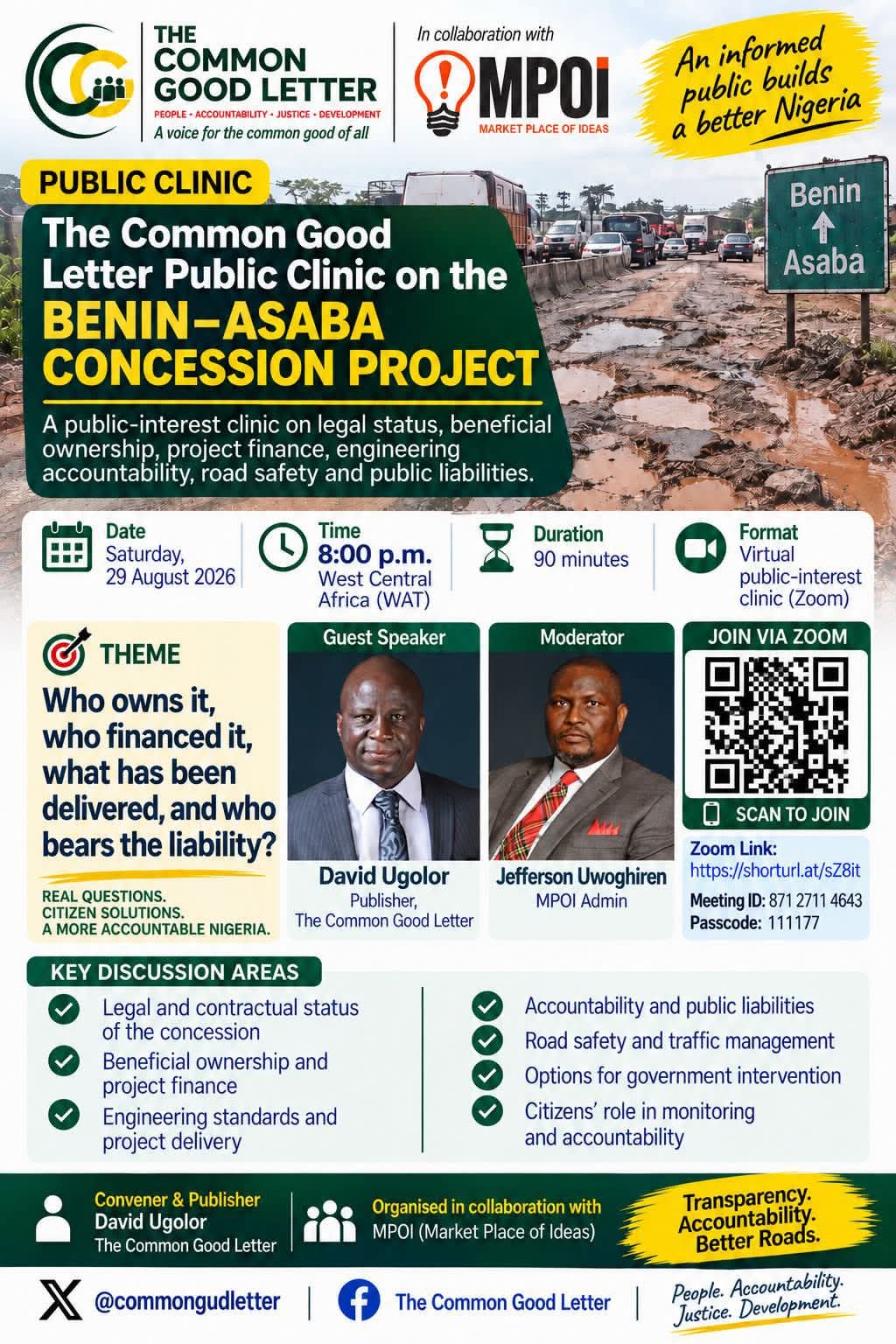
The demand followed a 90-minute virtual Public Accountability Clinic held on Saturday, August 29, 2026, organised by The Common Good Letter in collaboration with the Market Place of Ideas, with technical support from the African Network for Environment and Economic Justice (ANEEJ).
The clinic brought together lawyers, engineers, academics, journalists and concerned citizens to examine the governance and delivery of the road linking Edo and Delta states, a major transportation corridor connecting the South-South, South-East and South-West regions.
Rev. David Ugolor, Publisher of The Common Good Letter, and Jefferson Uwoghiren, moderator of the Market Place of Ideas, jointly delivered the lead presentation and raised concerns about what they described as weak disclosure and governance surrounding the project.
According to research presented at the meeting, the Benin-Asaba Express Concession Company Limited was incorporated as the special purpose vehicle for the project, with Ladikpo Oladipo Akinpelu reportedly holding 95 per cent of the shares and Ahad Narula holding five per cent.
Participants, however, noted that the ownership claims require documentary verification and that those named should be given the opportunity to respond.
The meeting also raised questions about the reported 25-year concession period, the projected ₦1.5 trillion revenue, the sources of equity and debt financing, and the role of the Infrastructure Concession Regulatory Commission (ICRC).
Participants said the full concession agreement was not publicly available, making it difficult for citizens and stakeholders to independently assess the obligations of the parties, financing arrangements and termination provisions.
Contributors also linked the poor state of the road to significant economic losses, including vehicle damage, travel delays, spoilage of agricultural produce, accidents and insecurity.
A claim that project progress stood at “less than 40 percent” was also debated during the clinic. Engineers at the meeting stressed the need for an independent assessment to determine the actual level of completion and distinguish the Benin-Asaba section from adjoining projects, including the Second Niger Bridge access road.
Legal experts at the clinic cautioned that although urgent government intervention may be necessary, any decision involving step-in rights, restructuring or termination of the concession must comply with due process to avoid potentially costly legal disputes.
They added that contractual protections should not be used to shield fraud or breaches of contract if such violations are established.
At the end of the meeting, participants adopted seven key resolutions aimed at improving transparency, accountability and road safety.
Among the resolutions were calls for the ICRC to publish the concession agreement, all amendments and financial summaries; disclose the ownership and financing structure of the project; and release Independent Engineer reports and verified project milestones.
The participants also called for immediate 30-, 60- and 90-day measures to address traffic control, drainage and road signage, as well as the establishment of citizen reporting channels for road hazards.
The organisers resolved to submit Freedom of Information requests to the Federal Ministry of Works, the ICRC and the concession company to obtain relevant project documents.
They also announced plans to hold a follow-up technical clinic involving an engineer to further examine the condition and progress of the road project.
The event ended with a call by the moderator for journalists to go beyond political statements and pursue evidence-based reporting on the project.
Citizens were equally encouraged to regard public infrastructure as their property and demand accountability from the authorities and other stakeholders responsible for its delivery.