
By Lucky Isibor
The Bishop of the Catholic Diocese of Uromi, Most Rev. Dr. Donatus Ogun, has declared that justice remains the foundation for genuine peace in society, urging citizens, institutions, and governments to embrace fairness, compassion, and human dignity in all dealings.
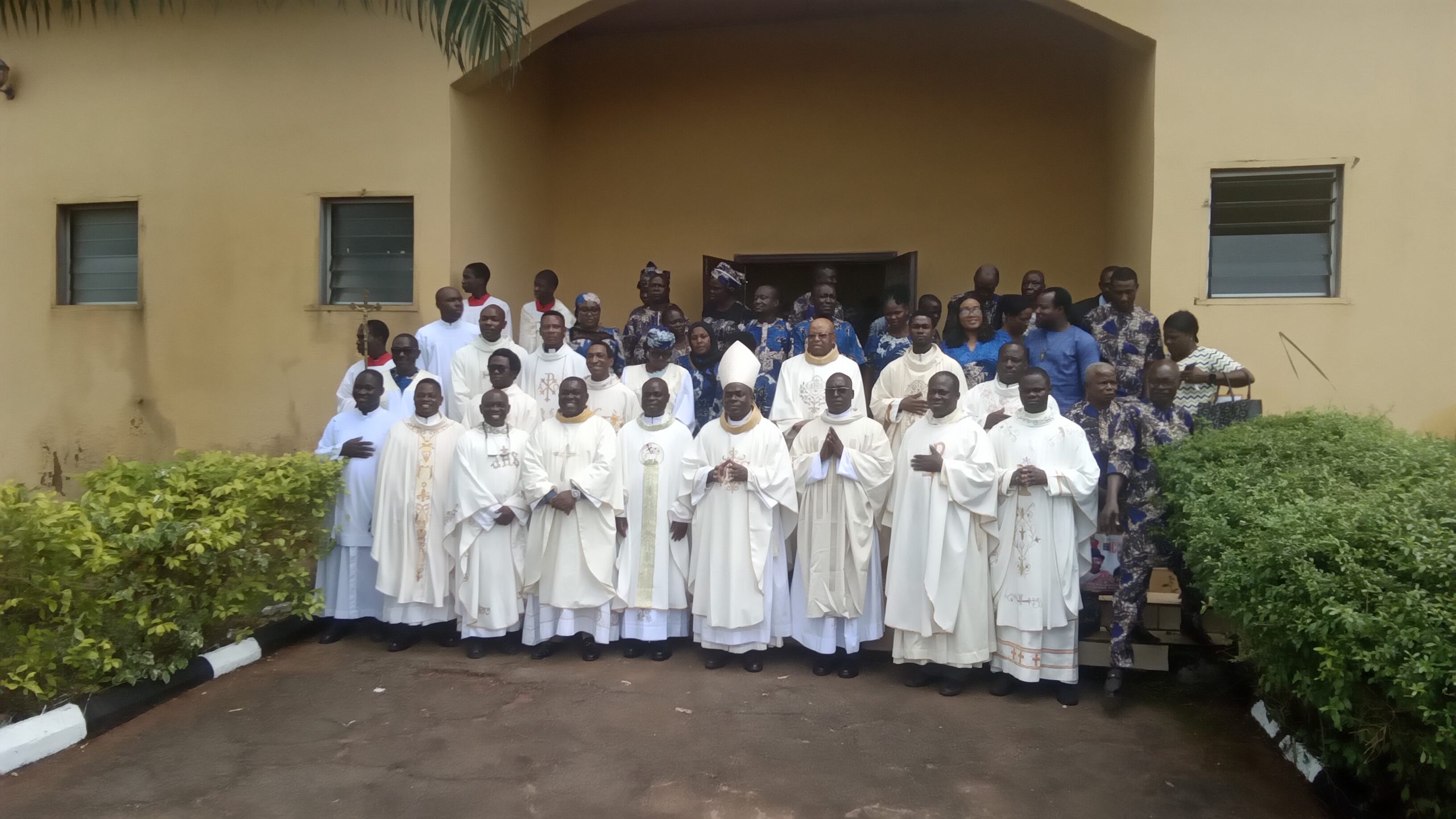
Bishop Ogun made the remarks on Wednesday, 20 May during the celebration of the 20th anniversary of the Uromi Justice Development and Peace Caritas Initiative (JDPCI), the social arm of the Catholic Diocese of Uromi.
Speaking at the event, the bishop emphasized that justice is not optional but a divine responsibility entrusted to all people irrespective of religion or status.
“Justice is the right of all and is what Jesus expects us to do. We explain justice in the words of Jesus: do unto others what you would want others to do unto you. So all of us, without distinction, are called to be agents of justice. Unless there is justice, there can be no true peace.”
The bishop described Uromi JDPCI as “the face of the diocese,” noting that the organization has consistently responded to the suffering of the poor, vulnerable, and marginalized over the past two decades.
“Wherever people suffer, you call the bishop. Wherever people are hungry, you call the bishop. The bishop says, ‘Go to JDPC,” he stated.
Drawing from a story about a damaged crucifix after the Second World War, Bishop Ogun likened the mission of JDPCI to believers becoming the hands and feet of Christ in society.
“The inspiration came: it has no hands, it has no legs. Don’t repair it, just hang it like that… You are the hands, you are the legs of Jesus. Anywhere you go, make sure you carry Jesus.”
The bishop also commended donor agencies, government institutions, traditional rulers, civil society actors, and indigenous communities for supporting the organization’s mission over the years.
“We thank our supporters from Germany and from Italy and other parts of Europe,” he said, while also acknowledging government support in areas such as anti-human trafficking and social interventions.
He urged communities to critically examine cultural practices that no longer promote justice and human dignity, particularly those affecting widows and vulnerable persons.
“If something is practiced against widows and it is obsolete, please let us look at it. It is justice if a widow is happy. It is injustice if she is made unhappy,” the bishop added.
Earlier in his welcome address, the Executive Director of Uromi JDPCI, Very Rev. Fr. Dr. Fidelis Oriabure Arhedo, described the anniversary as “a celebration of mission, sacrifice, resilience, partnership, and impact.”
According to him, the organization was founded 20 years ago to advance social justice and improve the lives of the poor and marginalized through faith-inspired interventions rooted in Catholic social teaching.
“Twenty years ago, inspired by the social teachings of the Church and the vision of building a more just, peaceful, and humane society, Uromi JDPCI began a journey of service to the poor, the vulnerable, and the marginalized across our communities,” he said.
Fr. Arhedo highlighted the organization’s major thematic focus areas to include human rights advocacy, migration and anti-trafficking interventions, gender-based violence response, child protection, prison apostolate, peacebuilding, healthcare support, environmental sustainability, microcredit empowerment, and community development initiatives.
He said the interventions had transformed thousands of lives across Edo Central Senatorial District and beyond.
“Through these interventions, vulnerable women and children have found hope and protection; survivors of trafficking and abuse have regained dignity; rural women and farmers have accessed economic opportunities; inmates have received rehabilitation and reintegration support; and communities have been empowered through civic education and human rights sensitisation,” he said.
The priest also announced the launch of two publications to commemorate the anniversary: the Uromi JDPCI Legacy Book and Codes of Esan Common Laws and Practices, the latter documenting customary laws from selected Esan communities as part of efforts to promote justice, peaceful coexistence, and cultural preservation.
He further revealed that one of the organization’s landmark achievements was the codification of customary laws and practices in 10 out of 35 kingdoms in Esanland through research supported by Misereor in 2025.
Fr. Arhedo used the occasion to pay glowing tribute to the Archbishop of Benin, Most Rev. Dr. Augustine Obiora Akubeze, for laying the foundation of Uromi JDPCI, and to Bishop Ogun for sustaining and expanding the initiative.
“With equal gratitude, I acknowledge the continued fatherly support of my Bishop, Donatus Ogun, whose encouragement, approval, and pastoral concern for the poor have sustained and expanded our work,” he said.
The Executive Director also expressed appreciation to donor agencies and development partners, including Misereor Aachen Germany, ECPAT France, ECPAT Luxembourg, Expertise France, Missio Germany, Palladium-SCALE Nigeria Project, the International Organization for Migration (IOM), Caritas Nigeria, UNHCR’s Telling The Real Story Project, ARFH, and GPI, among others.
He equally thanked government ministries and agencies, the Office of the First Lady of Edo State, traditional rulers, community leaders, and local stakeholders for supporting JDPCI’s interventions over the years.
In her goodwill message, the Coordinator, Office of the First Lady of Edo State, Mrs. Edesili Okpebholo Anani, praised Uromi JDPCI for remaining “a beacon of hope and service” over the past 20 years.
She anchored her remarks on the biblical parable from the Gospel of Matthew about caring for “the least” in society.
“I was hungry you didn’t give me food, I was thirsty you didn’t give me a drink. I was a stranger. You didn’t invite me in. I was naked. You didn’t cloth me. I was sick, in prison and you didn’t visit me.
And they said, Lord, when did all this happen? Because we didn’t see you. And he said, what you do to the least of your brothers and sisters is what you do unto me. And that is how we stand as Christians and what we represent here in the JDPCI.”
Mrs. Anani commended the organization’s advocacy for justice, peace, human dignity, and sustainable development, noting that its programmes had positively impacted countless lives across communities.
“Through your programmes, advocacy, and community interventions, you have continued to inspire collective responsibility toward building a more just, peaceful, and compassionate society,” she said.
She congratulated the Bishop, Board of Trustees, management, staff, partners, and supporters of the organization, praying that Uromi JDPCI would continue “to soar to even greater heights in service to God and humanity.”
High point of the celebration was the presentation of awards to deserving individuals and organisations in recognition of their exceptional contributions to the activities of Uromi JDPCI, including Bishop Donatus Ogun, the Bishop of Uromi Diocese, Archbishop Augustine Akubeze, the Archbishop of Benin, the Caritas Nigeria, among others.