
…….. unveils proposed secretariat as hub for counselling, empowerment
By Lucky Isibor
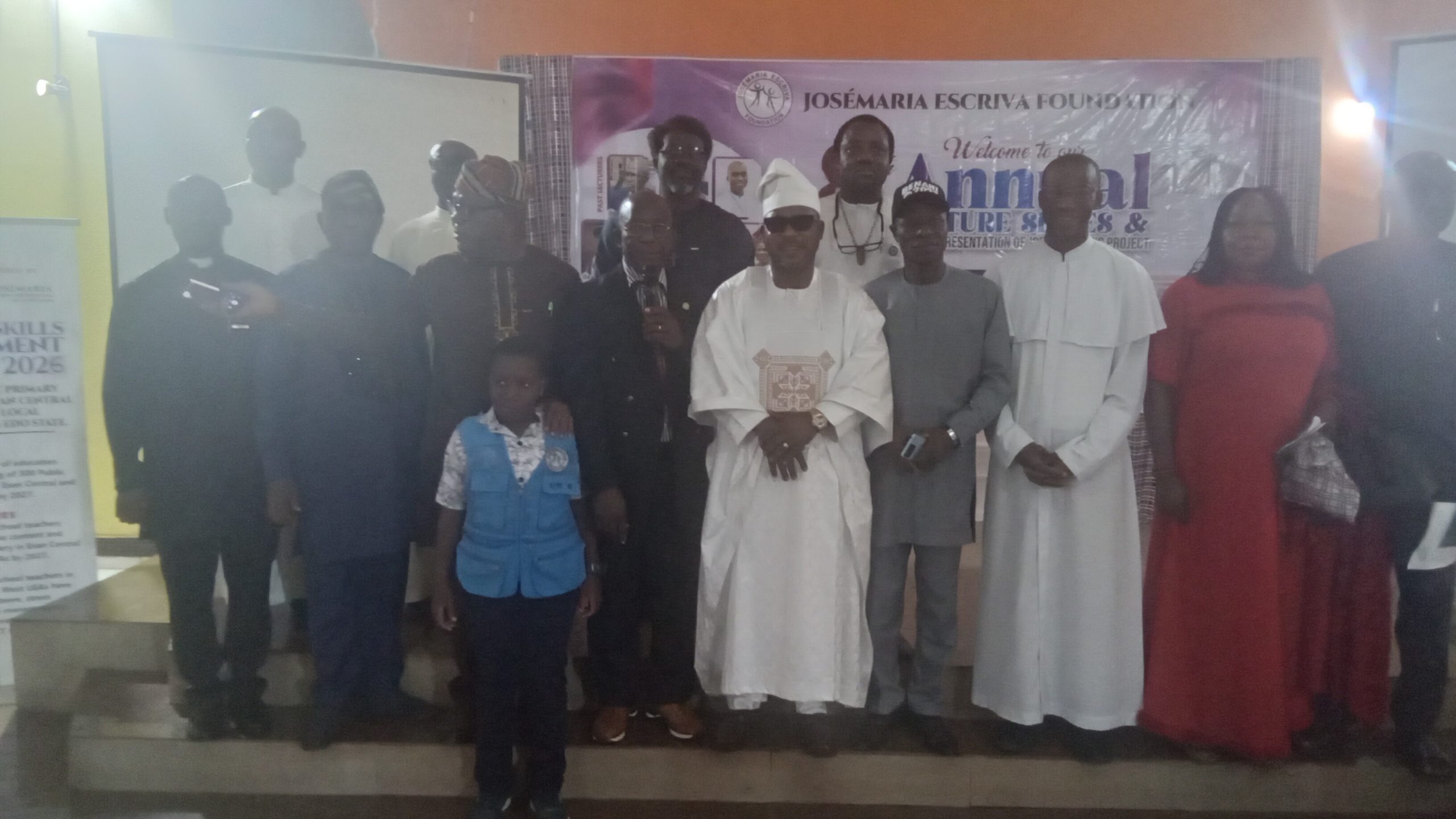
The need to strengthen Nigerian families as the first line of defence against insecurity took centre stage on Tuesday, 30 June as security strategist and corporate executive, Austin Odia Isikhuemen delivered the 8th Josemaria Escriva Foundation (JOSEF) Annual Lecture in Ekpoma, Edo State.
Speaking on the theme, “Household Havens: Forging Safer Communities Through Empowered Families,” Isikhuemen warned that rising insecurity across the country had weakened households through violence, kidnapping, displacement, unemployment and economic hardship, insisting that lasting security must begin from the family.
He described empowered households as those built on quality education, economic stability, good health, strong family values, active community participation, resilience and safety. According to him, “Safe households create empowered communities, and empowered communities create a stable and prosperous nation.”
The lecturer observed that insecurity had spread across Nigeria without boundaries, citing banditry, kidnapping, herdsmen-farmer conflicts and the movement of organised criminal networks into southern parts of the country. He referenced attacks on communities such as Woro and Nuku, where homes, food stores and infrastructure were destroyed while hundreds were killed or abducted, warning that the country was witnessing an expansion of Sahelian terror networks.
Isikhuemen said beyond economic losses, insecurity had inflicted severe psychological trauma, fragmented communities, increased caregiving burdens and left many families without breadwinners. He urged governments at all levels to strengthen security institutions, improve the economy, provide infrastructure and social services and protect schools and communities.
He also charged families to reinforce discipline, promote education, pursue economic empowerment, participate actively in community life, teach peaceful conflict resolution and adopt practical home security measures. “Government, communities and families must work together to confront insecurity. Hope is possible through collective action, resilience and empowerment,” he said.
The Chairman of the occasion, Sunny Ezeugwu, urged participants to take the message of the lecture back to their homes and communities, describing community development as “selfless development.”
“What are we taking home today? Everything we have heard today has centred on community development. Our duty today is to take this information first to our families. From there, it will spread to the entire society,” he said.
Ezeugwu praised the Josemaria Escriva Foundation for what he described as years of quiet but impactful service, saying, “I have monitored this foundation for over five, six or seven years, and it has simply remained committed to active service.”
He recalled how the foundation intervened when deteriorating roads prevented trucks from delivering goods into Ekpoma, resulting in severe scarcity and inflated prices. According to him, after he alerted the foundation to the situation, Dr. Jude Obasanmi and his team facilitated access for delivery trucks carrying goods to Ekpoma, restoring supplies to the town. “It was solved through selfless service. These are some of the things this foundation has done for society that were not mentioned today,” he stated.
Earlier, Chairman of the Board of Trustees of JOSEF, James Agbogun (Esq.), welcomed guests to what he described as a historic edition of the annual lecture, which also featured the unveiling of the Foundation’s proposed Secretariat and Resource Centre along Ukhun Road, Ekpoma.
He said the facility would serve as “a hub for counselling, empowerment and community care,” providing skills acquisition, youth empowerment, leadership development and community engagement programmes.
Agbogun highlighted the foundation’s achievements since inception, noting that JOSEF has become a leading non-governmental organisation promoting education, healthcare, good governance, youth development and community mobilisation. Among its accomplishments, he said, was the training of more than 380 teachers in Gen Z teaching methodologies with support from the TY Danjuma Foundation, alongside interventions in democratic governance, civic participation, sexual and gender-based violence advocacy, public health, mentorship, intellectual leadership and annual public lectures. He appealed to individuals, corporate organisations and development partners to support the completion of the proposed secretariat.
In a goodwill message, the Vice-Chancellor of Ambrose Alli University, Ekpoma, Prof. Eunice Omozejie, described the lecture theme as “both timely and profound,” stressing that “the family remains the bedrock of every society, serving as the first institution where values, discipline, integrity, compassion and civic responsibility are nurtured.”
She said the university shared JOSEF’s vision of developing responsible citizens through education and community service. “Beyond producing graduates, our mission is to develop responsible citizens and leaders who will contribute meaningfully to nation building,” she stated.
The Vice-Chancellor also commended the unveiling of the proposed secretariat, saying the counselling and care centre reflected “foresight and compassion” and would provide guidance and support for families facing personal and societal challenges. She added, “Such investment in human development deserves the encouragement and support of all stakeholders,” while congratulating Dr. Jude Obasanmi, noting that “Ambrose Alli University is very proud of you.”
Also speaking, Executive Director of the Uromi Justice, Development, Peace and Caritas Initiatives (JDPCI), Very Rev. Fr. Dr. Fidelis Oriabure Arhedo, described the lecture theme as a reminder that “strong families are the bedrock of peaceful, secure and prosperous communities.”
He commended the foundation for distinguishing itself “as a beacon of hope and transformation,” saying its programmes in public enlightenment, value reorientation, family development and community empowerment had earned recognition beyond Edo State. “I have witnessed firsthand its dedication, professionalism and positive impact on the lives of many people,” he said.
Arhedo appealed to individuals, government agencies, corporate organisations and development partners to support JOSEF’s work, particularly the construction of its proposed secretariat. “I encourage generous support towards the construction of its Secretariat, which will provide a permanent base for expanding its life-changing programmes and services,” he added.
The Onojie of Ekpoma, represented by Chief Emmanuel Omonua, also commended the foundation “for giving voice to the voiceless and protecting the lives of the vulnerable,” describing its interventions as invaluable to the community.
In an interview after the lecture, JOSEF’s Chief Responsibility Officer, Dr. Jude Obasanmi, said families must become central to Nigeria’s security architecture if the country hoped to address insecurity sustainably.
“The role of the family is crucial if we are to get it right. These criminals come from communities and families,” he said. “Families need to be empowered through employment opportunities, access to education, healthcare and other social amenities.”
Obasanmi argued that many parents desired responsible children but were sometimes driven by economic hardship to tolerate criminal behaviour. Referring to a drama presentation during the event, he said, “We saw a family celebrating because their child returned from fraud with millions of naira. When families are properly empowered, such tendencies will be drastically reduced, if not completely eradicated.”
He therefore advocated making families an integral part of government security policy. “Government can do everything possible, but if there is a disconnect between the family and what government is doing, we will continue to get it wrong. Nigerians are not asking for too much. Do the little that is necessary and create an enabling environment for Nigerians to give their best.”
A member of the Foundation’s Advisory Board, Prof. Matthew Izibili, described the annual lecture as timely but lamented the absence of many families who should have benefited from its message.
“This kind of lecture is meant for every family because when you talk about the family, you are addressing the root of society,” he said, adding that security extended beyond kidnapping and banditry to issues such as domestic violence, revenge practices and the examples parents set before their children.
According to him, “Children learn more through observation. If we do not put these issues in the proper perspective and address them, what we are witnessing today may only be the tip of the iceberg.” He concluded that tackling these underlying family issues would make Nigeria “a better country for it.”