
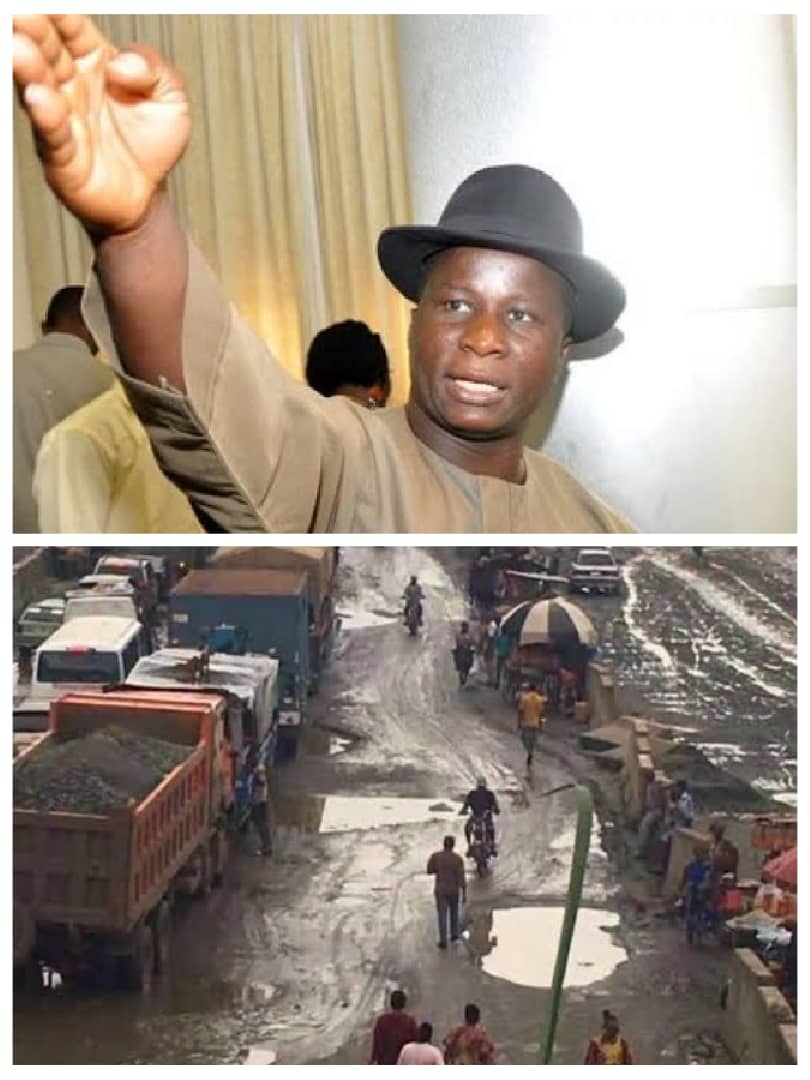
By Lucky Isibor
President Bola Ahmed Tinubu has been urged to order an independent probe into the controversial concession of the Benin–Asaba Road, following the collapse of the project and mounting losses suffered by motorists, commuters, businesses and residents along the corridor.
The call was contained in the latest edition of The Common Good Letter, an accountability publication by human rights activist and development actor, Rev. David Ugolor, which argues that the President’s recent intervention to address the deteriorating highway, though necessary, does not resolve the wider questions surrounding how the concession was awarded, financed, supervised and allowed to fail.
The publication said the Federal Government must move beyond blaming the concessionaire and reconstructing the road to establishing who took key decisions, what safeguards were applied, what warnings were ignored and who should ultimately bear the cost of the failure.
President Tinubu had ordered urgent intervention following widespread public concern over the condition of the highway, while the Minister of Works, David Umahi, subsequently said the concessionaire had failed in its obligations and indicated that the road would require major reconstruction and a review of the concession arrangement.
But The Common Good Letter maintained that reconstruction alone could leave taxpayers carrying the financial burden of a failure for which responsibility has yet to be conclusively established.
“President Tinubu’s order for urgent intervention is necessary, but it is an operational response—not yet an accountability response,” the publication stated.
It said the public accountability question was “wider than whether the concessionaire failed,” because government institutions were responsible for selecting, negotiating, approving, reviewing and supervising the concession.
The publication traced the history of the concession to January 18, 2023, when the Federal Executive Council approved the 125-kilometre Benin–Asaba corridor for a 25-year concession to Africa Plus Consortium.
It said the Infrastructure Concession Regulatory Commission (ICRC’s) public account projected about ₦1.589 trillion in concession-period revenue.
However, it identified discrepancies in publicly available descriptions of the project, including an ICRC bulletin that reportedly put a preliminary investment estimate at about ₦65.15 billion for a 100-kilometre scope, compared with later descriptions of a 125-kilometre, ₦228 billion transaction.
The Common Good Letter also pointed to an equity partnership reportedly signed by the Edo State Government on January 31, 2024, involving Africa Plus Partners, InfraCorp and AAA Infrastructure, saying the amount, ownership proportions, conditions and risk exposure require authoritative reconciliation with the original concession.
On February 12, 2024, the Works Ministry reportedly said it was reviewing the project parameters because of inflation, exchange-rate pressures, lower traffic and fuel-price effects.
The ministry’s proposed Renewed Hope terms included a reasonable construction period, verified bills of quantities, restrictions on variations without permission, completion of one carriageway before tolling and a government right to terminate for failure to meet completion deadlines.
At the March 23, 2024 flag-off, federal officials reportedly described the process as rigorous and transparent, with the Minister of Finance saying the cash was available and the consortium had committed the full capital.
By August 2026, however, the situation had deteriorated dramatically.
The Works Minister said on August 16 that the road had been concessioned rather than neglected, warned that arbitrary termination could expose government to major claims and said the ministry had been demanding improved performance.
Between August 20 and 25, public protests and severe gridlock intensified. The concession company attributed the setbacks to prolonged rainfall, drainage deficiencies, premature traffic loading and construction on a busy corridor, while announcing a recovery programme from October 2026 and completion targets extending into 2028.
The Minister subsequently alleged that more than 30 kilometres of asphalt had been removed and said the concessionaire had failed.
President Tinubu then ordered urgent intervention, with the Presidency characterising the problem as an isolated failure and placing responsibility on the contractor.
The road’s deterioration has transformed what should be a major economic artery linking Edo and Delta states into a source of prolonged hardship for road users and communities along the corridor.
Motorists face extended travel times, traffic gridlock, vehicle damage and increased operating costs, while passengers risk being stranded for hours.
Businesses located along the road corridor have also faced disruption as traffic becomes unpredictable and access to commercial centres and communities is impaired.
Transport operators, who depend on predictable journey times, face higher fuel consumption, maintenance costs and reduced vehicle utilisation when journeys that ordinarily take considerably less time become prolonged ordeals.
The publication argues that the consequences extend beyond inconvenience.
Its accountability framework specifically calls for mechanisms to document deaths, injuries, vehicle damage, stranded passengers and business disruption, with redress where liability is established.
It also warns that removing pavement from a busy highway without adequate drainage, traffic diversion, construction resources and sectional completion arrangements can compound the original problem by exposing road users to further deterioration and safety risks.
According to The Common Good Letter, the central issue is not simply whether the concessionaire performed poorly but whether the institutions responsible for the concession exercised appropriate due diligence and oversight.
Under the ICRC Act, the publication noted, the responsible ministry is expected to ensure that a project proponent possesses the necessary financial capacity, expertise and experience, while the ministry supervises the concession and the ICRC monitors compliance.
The publication therefore called for an independent technical, contractual and financial review capable of establishing responsibility across the entire chain of decision-making.
It said such an investigation should determine who authorised major decisions, what engineering and financial evidence supported them, what safeguards existed, what government officials knew and when, and what enforcement actions were taken.
The publication’s position is that emergency repairs should continue while the investigation proceeds.
“The appropriate public position is firm but fair: emergency repairs must proceed immediately, while an independent technical, contractual and financial review establishes facts, protects the government from avoidable liability, prevents a taxpayer bailout and identifies responsibility on every side,” it said.
The Common Good Letter proposed several broad sets of measures, ranging from immediate protection of road users to reform of the Federal Government’s highway concession model.
“Publish a dated emergency traffic and safety plan covering diversions, towing, drainage, temporary surfacing, signage, night visibility, ambulance access and responsible officials for every affected section.”
It further calls for an independent road-safety and geotechnical assessment and says its executive findings should be published within 14 days.
“Stop further wholesale pavement removal unless a section-by-section method statement proves that reconstruction resources, drainage, traffic diversion and independent engineer approval are in place.
“Establish a single public complaints and incident channel for deaths, injuries, vehicle damage, stranded passengers and business disruption; preserve evidence and provide redress where liability is established.”
The publication calls on President Tinubu to direct a time-bound joint review led by an independent chair, involving the Auditor-General, ICRC, Federal Ministry of Works, Federal Ministry of Finance, legal and engineering experts, with observers from the National Assembly, Edo and Delta states and civil society.
It says the review should reconstruct the decision trail covering procurement, FEC approval, concession execution, financial close, the 2024 renegotiation, state equity arrangements, mobilisation, pavement-removal approvals, monitoring reports, warnings, cure notices and proposed restructuring.
“Require a forensic technical audit of quantities, quality, drainage design, completed work, removed pavement, site assets, equipment deployment and cost to restore the corridor.
“Require a financial-capacity audit showing actual equity paid in, committed and drawn debt, investors and lenders, performance bonds, guarantees, insurance, related-party contractors and any contingent public liability.”
The Common Good Letter calls for publication of the concession agreement and schedules, subject only to lawful and clause-specific redactions.
It wants government to publish the Full Business Case compliance certificate, FEC approval, letter of award, financial-close certificate and every approved amendment or variation.
“A plain-language project summary showing the authoritative project value, 125-kilometre scope, construction phases, milestones, risk allocation, tolling assumptions, revenue forecast, performance standards, penalties, default/cure provisions and termination-payment rules.”
The publication also calls for disclosure of the legal and beneficial ownership of BAECC, Africa Plus Consortium and material contractors, including the equity shares and obligations of Edo State, InfraCorp, AAA Infrastructure and other investors or lenders.
It additionally wants independent engineer reports, Ministry and ICRC monitoring reports, performance failures, notices to cure and sanctions published.
“In recovery; lender or government step-in; replacement of the construction contractor; consensual restructuring with stronger security; negotiated termination; or arbitration/termination for default.
“Do not extend the concession period, raise toll assumptions, grant guarantees or inject public money until an independent value-for-money and fiscal-risk assessment is published and approved through the required process.”
It calls for emergency public spending to be ring-fenced and recorded as recoverable against the responsible party where the contract and law permit, and for every emergency procurement and payment to be published.
It further recommends that the Attorney-General and ICRC publicly certify that the chosen remedy minimises termination exposure while preserving government enforcement rights.
It also wants the National Assembly Works Committees to hold a public, evidence-based hearing and publish findings, recusals and recommendations.
“Create a Benin–Asaba Public Performance Dashboard showing section-by-section work, targets versus achievement, safety incidents, independent certifications, payments, penalties and complaints resolved.”
The publication also proposes a citizen monitoring group comprising road users, transport unions, host communities, professional bodies, Edo and Delta civil society and independent media.
It recommends quarterly reporting until safe, continuous passage and verified construction milestones are achieved.
The final recommendation is to make financial close, beneficial ownership, performance bonds, independent engineering certification and disclosure prerequisites for site handover and destructive work on existing public assets and called for “maintain access before removal” rule under which no concessionaire would be permitted to strip long sections of a live highway without ready financing, drainage, materials, equipment, diversions and enforceable sectional completion dates.
The publication also recommends public dashboards and annual value-for-money, fiscal-risk and user-satisfaction reviews for every federal highway concession.
“Apply the same accountability review across the HDMI portfolio so the Benin–Asaba failure becomes an early-warning lesson rather than a repeated pattern.”
The publication posed 10 questions which it says President Tinubu should answer publicly:
“What is the authoritative concession value, financing structure and current fiscal exposure of the Federal Government and Edo State?”
“When was financial close achieved, and what independently verified proof showed that full financing was available before mobilisation?”
“Who are the legal and beneficial owners, equity investors, lenders and principal contractors behind BAECC and the Africa Plus Consortium?”
“Who approved removal of more than 30 kilometres of asphalt, based on what engineering and traffic-management plan?”
“What did the independent engineer, Works Ministry and ICRC report before the crisis, and what notices, penalties or cure deadlines were issued?”
“Why did officials publicly assure Nigerians in March 2025 that the process was rigorous and the cash was available if the project later lacked adequate delivery capacity?”
“Which contract clauses now govern cure, step-in, replacement, restructuring or termination, and what compensation exposure attaches to each option?”
“Who will finance emergency works and total reconstruction, and how will government prevent double payment or a bailout of private investors?”
“What relief and grievance process will be available to people who suffered documented injury, loss or severe disruption?”
“By what dates will the contract summary, monitoring reports, audit findings, recovery plan and quarterly performance data be published?”
The letter argues that answers to those questions are essential if the government is to prevent the road’s reconstruction from becoming an exercise in transferring private-sector failure to the Nigerian.
The Common Good Letter said the controversy should not be reduced to the condition of a single highway or attributed solely to the difficulties of the rainy season.
“It is a test of whether Nigeria’s PPP system can disclose decisions, enforce contracts, protect citizens and assign responsibility when a flagship concession fails to deliver,” it stated.
“Reconstruction without disclosure may restore the road while leaving the governance failure untouched—and may transfer private failure back to taxpayers,” it warned.
“Fix the road now; disclose the deal; audit the failure; protect the public purse; enforce the contract fairly; and publish who is responsible for what.”