
By Lucky Isibor
The DeeMoat Hub has called for a strategic partnership with the Edo State Government to train public sector workers in artificial intelligence (AI) and digital technologies, while equipping young people with the skills to become AI and digital entrepreneurs and take advantage of opportunities in the global digital economy.
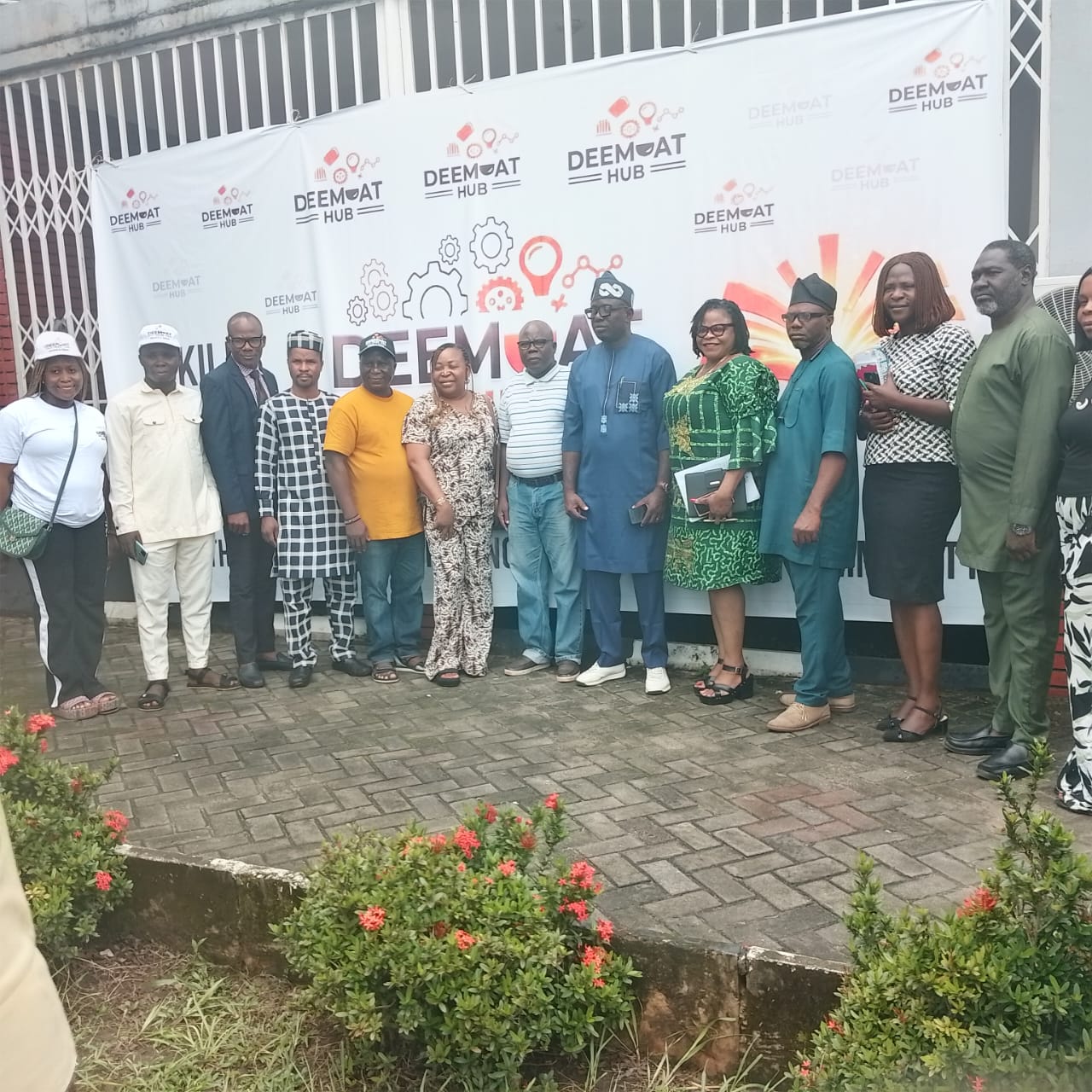
The Founder and Executive Lead of DeeMoat Hub, Rev. David Ugolor, made the call when the Edo State Commissioner for Communications and Digital Economy, Prof. Omorodion Ikponmwosa, paid a courtesy visit to the hub.
Ugolor said the proposed partnership would focus on strengthening the digital and AI capacity of government officials, developing the next generation of technology entrepreneurs and creating practical pathways through which Edo youths could participate profitably in the rapidly expanding global digital economy.
He said DeeMoat Hub was established to provide a safe and welcoming environment where people could learn, exchange knowledge, test ideas and acquire practical skills capable of transforming ideas into useful products and services.
“I founded DeeMoat Hub because people need a safe and welcoming space where they can read, learn, exchange knowledge, test ideas and acquire the skills needed to transform those ideas into useful products and services.
“DeeMoat Hub is open to people of all ages. We believe that an experienced professional, an entrepreneur, a student, a public servant and a retired professional can each learn something valuable from the others. This intergenerational exchange is central to our identity: People, Ideas and Impact.”
According to him, the hub is developing a range of programmes, including the DeeMoat Digital Economy and AI Skills Lab, which he described as a permanent platform for learning, innovation and institutional partnerships.
He said the Skills Lab would host short courses, webinars, digital-literacy programmes, public conversations, innovation activities and practical demonstrations of emerging technologies throughout the year.
Ugolor also disclosed plans for an eight-week DeeMoat AI and Digital Skills Accelerator, through which participants would undertake practical assignments and capstone projects and learn to apply digital and AI tools to employment, professional practice, entrepreneurship and enterprise development.
He said the hub was also developing a Public Sector AI Capability and Responsible Digital Government Programme in collaboration with relevant government institutions.
“Honourable Commissioner, we are also developing the DeeMoat Public Sector AI Capability and Responsible Digital Government Programme. Through this programme, we want to work with the Ministry of Communications and Digital Economy to strengthen the capacity of public officials to understand, procure, govern and apply artificial intelligence responsibly.
“This has become particularly timely.
“The newly released Global Skills Report 2026 shows that AI deployment is moving much faster than workforce preparation. Nearly three in four organisations have deployed or are piloting AI, yet only 18 per cent report that most of their workforce participated in AI reskilling or upskilling during the previous year.”
Ugolor said DeeMoat Hub wanted the proposed collaboration to extend beyond technology training to include responsible AI adoption, governance, data protection and practical applications of technology to public-sector challenges.
“We respectfully propose a practical partnership between the Ministry and DeeMoat Hub built around four areas.
“First, we can support the nomination and preparation of an Edo State public-sector cohort for the new African Development Bank training programme.
“Second, we can jointly organise introductory AI-capability sessions for officials across ministries, departments and agencies – not only technology officers, but also personnel working in procurement, planning, education, agriculture, public information and service delivery.
“Third, we can support the development of practical guidance on approved AI tools, sensitive-data handling, human review, cybersecurity, audit trails and accountability for AI-supported decisions.
“Fourth, DeeMoat Hub can provide a community-based environment for controlled demonstrations and pilot projects. These should begin with clearly defined public problems and include proper baseline information, data-protection safeguards, evaluation and opportunities for citizens to provide feedback.”
Ugolor said the ultimate objective was to ensure that technology translated into tangible benefits for citizens and institutions.
“Our purpose is not to promote technology for its own sake. We want technology to improve people’s lives, strengthen public institutions, expand access to opportunity and ensure that no group is left behind.
“We believe AI should augment the abilities of public servants, entrepreneurs, professionals and citizens – not remove human responsibility or weaken public accountability. Training must therefore extend beyond senior officials to the frontline workers who will use these systems and the citizens whose lives may be affected by them.”
He added: “We want to see a synergy between our hub and the government, building a society where we can turn every technology opportunity to become the benefit of the people. I think the whole essence of what we are doing here today is all about the younger generation. The emerging technology is all about the digital world.”
Responding, the Commissioner for Communications and Digital Economy, Prof. Omorodion Ikponmwosa, described DeeMoat Hub as a potential partner in the state government’s efforts to expand opportunities in the digital economy.
The Commissioner said the visit had reinforced his conviction that the hub could contribute to the ministry’s mandate of developing the state’s digital space and creating opportunities for its people.
“Having listened to you very attentively, I can say that we have found a very genuine partner as a ministry, a reliable and dependable partner that we can collaborate with for our mandate to be actualized.
“And the mandate of the ministry is simple, to develop the digital space, create opportunity for our people. And this is exactly what we are doing.
“Mr. Governor did not just create the Ministry of Digital Economy by accident. It was a deliberate decision because of the potential inherent in the digital space.
“It is one sector that has the potential to create a number of jobs for our people. And for us as a ministry, we are determined in exploring the opportunity in the digital space.”
Ikponmwosa said the government’s digital economy agenda would cover areas beyond artificial intelligence, including coding, robotics, the Internet of Things and other emerging technologies.
He said the challenge was to ensure that young people received the appropriate, competence-based training to enable them to participate in the opportunities presented by the digital economy.
“We are talking of creating opportunities and working remotely. People, it’s not possible to work here in Nigeria. You are stationed in Nigeria and work in America and earn money. But how do we maximize these potentials? How do we ensure that our people tap into these potentials?
“We must be able to structure it in a way and manner that our people can come in, have the right training.
“A training that will be competence-based, like you rightly mentioned. A training that will not be dependent on just insurance or safety kit, but competence-based.
“So for us as government, as ministry, we are looking at partners that we can work with. We have conducted what we call a skill audit. And we find out that the digital space is so wide that we need to take advantage of it.”
The Commissioner said the government would work with private-sector organisations and other stakeholders to bridge identified skills gaps.
“We need to educate our people, draw our young ones. We are iGen Z generation now. So, you know, they abuse this thing a lot. Instead of using it to develop potentials that can give them food on their table.”
He said the ministry would establish a team to work with DeeMoat Hub on areas of possible collaboration.
“We’ll set up a small team that will be working with you. And we are available to work with you,” he said.
On the need to introduce emerging technology skills to pupils and students, Ikponmwosa said the government would have to consider reviewing the school curriculum to ensure that learners were equipped with relevant digital knowledge from an early stage.
“But one way as a government that we can realize that is again to retool our curriculum at the school level. So that some basic courses, and that is something I think we can do with this kind of partnership.
“We have to look at the basic things, in a way and manner that we can look at the curriculum and see how we can retool or redesign the curriculum so that from the basic school, the basic knowledge is incorporated so that the children, the learners can move with the trend.”
The Commissioner stressed that both teachers and learners would need to move with technological changes.
“The fourth industrial revolution is like an explosive. If you don’t move with it, the world will leave you. So we must make sure that our children, the learning environment, the instructors, the learners, everybody must move together.”
He said connectivity would also be critical to extending digital opportunities to schools and communities across the state.
According to him, the state government was working towards ensuring that the 18 local government areas were connected to the internet.
“The first thing is connectivity. To create assets. Alright?
And in this state today, we have a government that is passionately committed to creating assets. We are reviewing on how we can ensure that the 18 local governments of those states are connected to internet.
Once there is access, then we have carried this infrastructure to the grassroots.”
He, however, cautioned that increased connectivity must be accompanied by responsible use and appropriate safeguards, particularly for children.
“But again, I must warn at this juncture. Because this thing carries a lot of things. We must restrict access. Parents have a role to play. You should not say, okay, there’s connectivity and every child should just be allowed to navigate our web. There should be restriction. But we must use this for the benefit of creating an opportunity for our children.”
The DeeMoat Hub AI Officer, Ofejiero Agbaduta, told the visiting government officials that the hub was already developing AI-powered applications for businesses, schools and security-related purposes.
He said the hub had developed applications for inventory management and was also working on solutions involving CCTV footage analysis, school dress-code compliance and security identification.
“We have developed applications for retail shops, even for big businesses to manage their inventory. We are developing applications for CCTV footage, for universities, detecting, solving their problems, e.g., what standard is a school dress code like?
“We are developing a system that can tell, okay, is this student following the standard? Is he or she not following the standard?
“We have developed CCTV camera software that can detect if it’s seen a stranger, if it’s seen somebody it knows for security purposes.”
Agbaduta also highlighted the need for locally controlled AI systems, particularly where sensitive government information was involved.
“We also have deep knowledge about AI. We have some AI systems running in us, learning to use the internet, working on our own infrastructure.
“And I feel that that is one aspect that our government will even need because it’s not all government information you put into ChatGPT because some foreign countries begin to see, you know, begin to restructure your government secrets in their own database.
“So these kind of solutions are things that our government needs, our teachers need, and all these are things that we already have available in us and already have deep knowledge of already.”
The Director of Digital Economy and Innovation in the Ministry of Communications and Digital Economy, Frank Egbeobawaye, said he was particularly interested in the hub’s demonstration of technology aimed at protecting government data.
Egbeobawaye said the protection of government information was among the challenges confronting the ministry and had contributed to concerns over the deployment of AI across government operations.
He said the development demonstrated at DeeMoat Hub could help address those concerns and create greater confidence for the government to embrace AI applications.
The visit ended with indications from the ministry that it would explore structured collaboration with DeeMoat Hub in the areas of digital skills development, AI capacity building, public-sector innovation, youth entrepreneurship, school-level digital education and responsible adoption of emerging technologies.