
laud manifestations of a book authored by him and Browne, an American
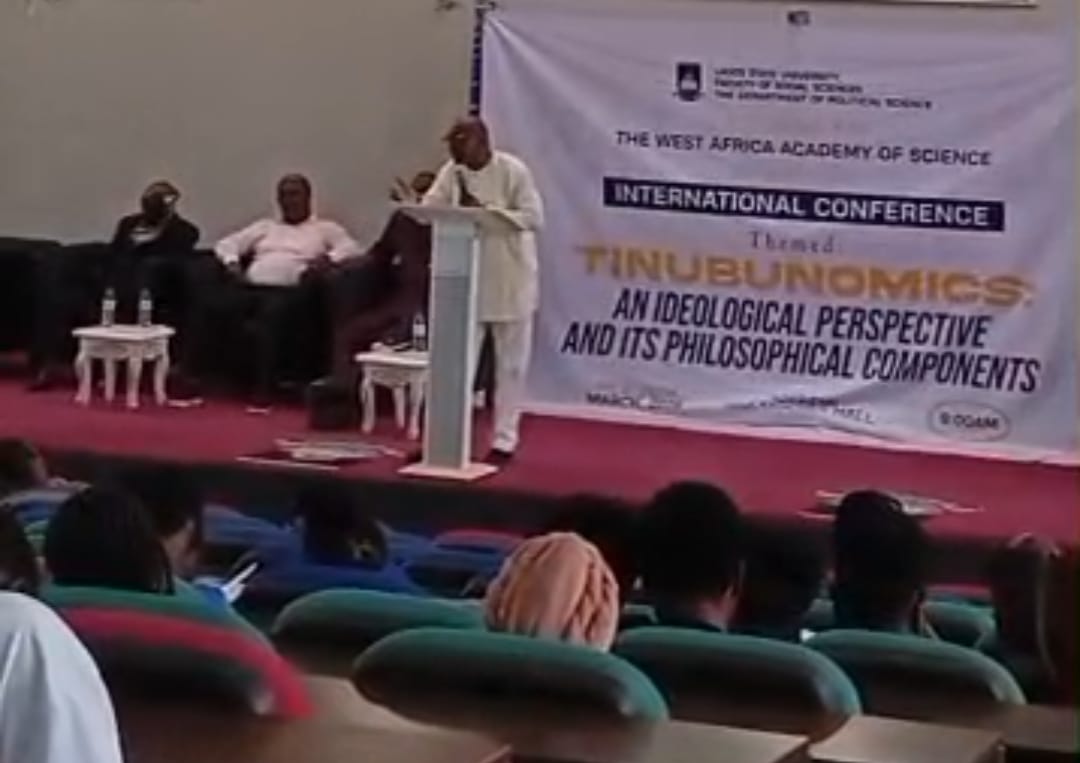
The academia, in an international conference put together by the West Africa Academy of Science and the Department of Political Science, Lagos State University(LASU), has drawn attention to the interrogation of a published book co-authored by President Bola Ahmed Tinubu and Brian Browne, a black American. The session, which had Professor Akpan Ekpo delivering the Keynote address, began with the highlights of Dr Abdul Wasi Babatunde as well as a member of the organising committee. Mr Michael Igaga, the Executive Secretary of the West Africa Academy of Science.
Mr Igaga posited that the beauty of the conference was that it furthered the vision of African academics and ideologues in the quest of finding solutions to Africa’s development from an Afrocentric perspective, with Igaga further arguing that African economies have failed to effectively respond to imported narratives that do not intuit into the African metaphysical world view and perspective.
According to him, the submissions of President Bola Ahmed Tinubu and Brian Browne in the book, “Financialism: Water from an Empty Well,” has a universal ideological focus as it effectively situates the Nigerian development question and what ought to be done for the economy to effectively respond to proffered solutions.
Igaga averred that the book delivers a systematic process to development, which by its comprehensive content, shows the character of an ideological postulation. The submissions of the authors, in his view, were on a systematic growth process that are scientifically located, stating that the submissions of the book were on the need for countries, he defined, as embryonic countries, to use the base things of their economic endowment as stepping stones to their development.
In the case of Nigeria, the authors’ position, he said, was that agriculture is taken as the base station, pointing out that Tinubu and Browne clearly specified the basic role of the environment and climate in the evolvement of a development trajectory, stating that in
the joint work, Bola Ahmed Tinubu and Browne had argued that Nigeria move from improved agriculture production to meet domestic consumption to exploring the export market.
According to Igaga, with the breakthrough at the level of export, the inflow into the economy enhances further trading activities which they classified as mercantilism. Enhanced mercantilism, according to Tinubu and Browne, encourages second order conversion process, which escalates the development of cottage industries, bringing expanded economic activities to the rural areas while increasing trading and engendering greater wealth in the entire economy of a country.
Tinubu and Browne, Igaga noted, postulated on the emergence of a country that becomes non-dependent and competitive in the global market and its economic relations. It is the view of Tinubu and Browne, in their book, that with movement from the export of primary product to the export of processed and finished product, the economy will not only generate wealth but retain wealth. This is because the country won’t export raw materials to be processed and recycled back to her for purchase again. The country would have strained capacity for exporting finished products that would also be serving its own local industries.
On the whole, Igaga argues that the Tinubu model submits that from Agricultural advancement and conquest of the world market, Nigeria will achieve a balance of trade, and with the agricultural conquest engendering more wealth, the country could move into conversion of agricultural products from their primary source to second layer application.
At that level, of maximum profit from agriculture, the economy, he said, will be generating enough capacity for industrial production and finishing. With the country achieving industrial production and finishing, it would begin to compete with multilateral production firms rather than depending on imports for survival. This, Igaga said, captures Tnubunomics as an ideological paradigm for development.
Dr Temidayo Oladipo of Afe Babalola University argues that to complete the ideological component of Tinubunomics, Tinubu and Browne scrutinised the nature of man and man’s capacity for sustained moral suasion. Oladipo situates this as a deep philosophical reflection that takes the works of Tinubu and Browne to a comprehensive articulation of an ideology synthesis. In his view, ideology is not just about economic models, it must effectively relate with the factors that define or ought to define human behaviour, social relations and community. The work, “ Financialism: Water from an Empty Well,” effectively encapsulates this narrative.
In Dr Amaechi Nwador’s submission, he dismissed the categorisation of the works of Tinubu and Browne within the limiting confines of Pan Africanism or as reflecting neo-liberal thoughts, stating that to localise the submissions in the book as Pan Africanist because Bola Ahmed Tinubu is an African and Brian Browne , a black American is an appalling intellectual misnomer.
He posited that when a textual analysis of the book is done, it is clear that the views of the book are original thoughts that escalate the dimension of ideological discourses on emerging economies.
Similarly in the views of Kennedy Ifeh, one of the authors of the titles, Tinubunomics, an Ideological Perspective and its Philosophical Components, the policies of President Bola Ahmed Tinubu in the devaluation of the Naira is not a spontaneous jump start. It is a well thought out perspective that makes the Nigerian agricultural products more competitive in the international market.
In his opinion, today’s Nigerian farmer is much more enhanced economically than ever, stating that if the economy achieves industrial production, the impact of these policies will become more holistic.
Professors Akpan Ekpo and Odion Akhaine didn’t wholly agree with that position as they were a little bit more critical in their evaluations, even though their opinions had immensely benefited the academic delivery of the session.
In a post session interview with Mr Igaga, the Executive Secretary of West Africa Academy of Science, he argued that subjecting the ideological perspective of President Bola Ahmed Tinubu to intellectual interrogation is beneficial to the vision of the Academy to evolve an African based and focused development paradigm that would draw from an African determined philosophical and ideological paradigm.