
By Lucky Isibor
The Executive Director of the Uromi Justice, Development, Peace and Caritas Initiative (Uromi JDPCI), Very Rev. Fr. Dr. Fidelis Arhedo, has declared that no child or adult should ever be treated as “a commodity to be bought, sold or exploited,” urging communities, government institutions and other stakeholders to sustain the fight against human trafficking beyond the lifespan of donor-funded interventions.
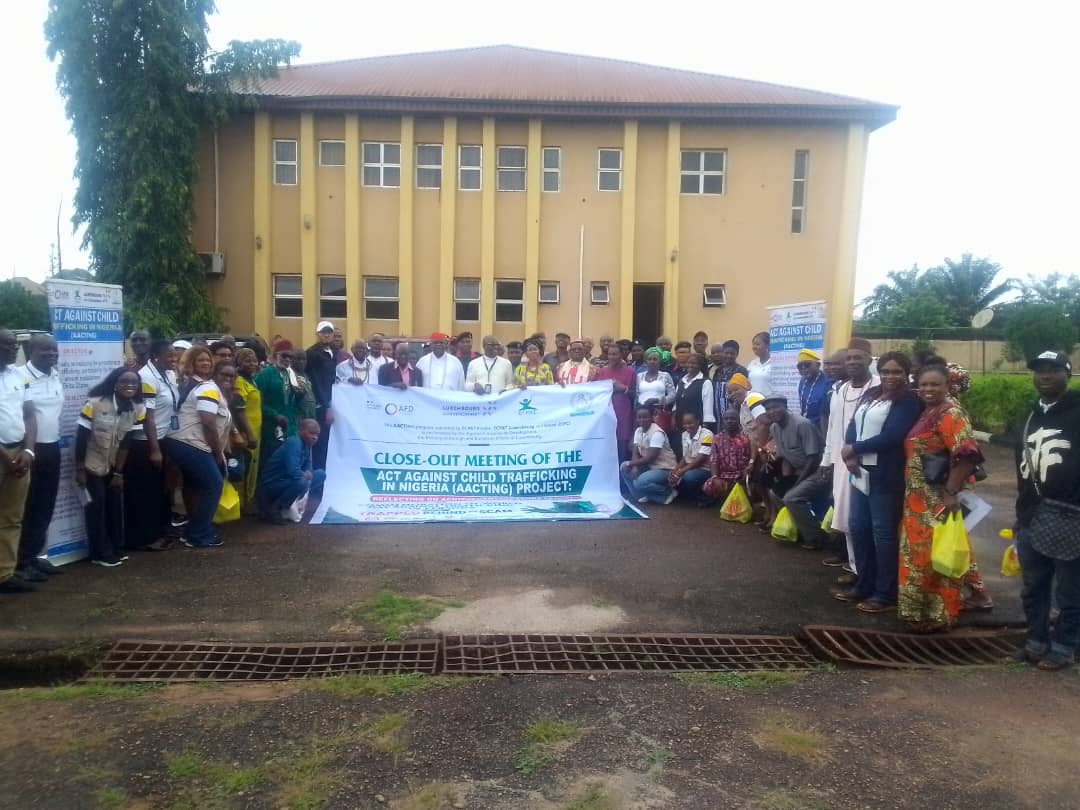
Fr. Arhedo spoke in Uromi, Edo State, during the close-out ceremony of the three-year Act Against Child Trafficking in Nigeria (AACTING) Project and the commemoration of the 2026 World Day Against Trafficking in Persons, where stakeholders reaffirmed their commitment to protecting children and combating human trafficking.
Describing the gathering as “a moment of reflection and appreciation,” Fr. Arhedo said the completion of the project represented more than the end of a programme but “a reaffirmation of our shared responsibility to uphold the dignity of every human person.”
“The Church teaches that every person is created in the image and likeness of God; therefore, no child or adult should ever be treated as a commodity to be bought, sold or exploited. Human trafficking is not only a crime against humanity but also a grave sin against God because it attacks the sacred dignity bestowed upon every human life,” he said.
He warned that although the AACTING Project had ended, the mission of protecting children and vulnerable persons must continue.
“Projects may end, but our mission does not. The structures we have built, the partnerships we have formed and the knowledge we have shared must continue to protect our children and strengthen our communities,” he stated.
Drawing attention to the 2026 World Day Against Trafficking in Persons theme, “Trapped Behind the Scam,” Fr. Arhedo warned that traffickers were increasingly exploiting victims through fake overseas job offers before forcing them into cybercrime operations under violent conditions.
He outlined how traffickers lure victims with promises of lucrative employment, confiscate their travel documents upon arrival, detain them in heavily guarded compounds and compel them to engage in romance scams, cryptocurrency fraud, fake investment platforms, business email scams and other online financial crimes while using violence, threats, debt bondage and constant surveillance to maintain control.
The Catholic priest expressed appreciation to the project’s implementing partner, ECPAT France and Luxembourg, donor Agence Française de Développement (AFD), government institutions, law enforcement agencies, traditional and religious leaders, schools, community structures, civil society organisations, the media, parents, caregivers, transport unions, market women, community child protection actors and all other partners whose collaboration, he said, made the project successful.
Making a presentation on and reflection on key milestones, achievements, lessons learnt, challenges and next steps; the Director of Programmes at Uromi JDPCI, Dr. Michael Iyioriobhe, said the AACTING Project, which commenced in September 2023, focused on preventing child trafficking through community-based protection systems rather than awareness campaigns alone.
According to him, the project established Child Protection Committees in communities, Child Protection Groups across the five local government areas, and Child Champion Clubs in 15 communities and 15 schools to involve children directly in safeguarding efforts.
He said extensive capacity building was carried out for community leaders, religious leaders, caregivers, security agencies and other stakeholders, resulting in stronger collaboration and improved responses to trafficking cases.
Iyioriobhe noted that security agencies, particularly the Nigeria Security and Civil Defence Corps (NSCDC), had significantly improved their capacity to prevent trafficking and facilitate the repatriation of trafficked children from countries such as Mali, Togo and Ghana.
“We built capacity around prevention, integration, coordination and collaboration,” he said.
“Fighting child trafficking has to begin at the local level because if you do not have the institutional structures to prevent it there, you will only be responding at the higher level. Prevention is always better than response.”
He added: “Today, we are seeing a very high level of response. We are seeing improved capacity. We are seeing stakeholders who are willing and committed to sustaining the impact of the project.”
Also speaking, the Pentecostal Archbishop of Esanland and Chairman of the Esan United College of Bishops, Archbishop Dr. Anthony Okosun, recounted how a Nigerian woman operating in the United Kingdom deceived young girls with promises of decent jobs abroad only to force them into prostitution.
“Many souls have been saved. Many lives that could have been destroyed have been saved, and we have learned a lot,” he said.
Although the programme had formally ended, he stressed that “the task of saving our people from human trafficking is a task that must be accomplished.”
Archbishop Okosun also warned that trafficking was not limited to taking victims overseas.
“Human trafficking is not only about taking people to London. It also happens in our homes,” he said, condemning the exploitation of young domestic workers and urging families to end all forms of servitude.
Representing the Onojie of Igueben, His Royal Highness Eiluojierior II, Chief Hillary Ekhoye commended Uromi JDPCI for sustaining the initiative over three years and ensuring that awareness reached communities across Edo Central.
“The fact that it has officially ended today does not mean all our communities should go to sleep. Child trafficking is a crime against humanity,” he said.
He called for continuous enforcement of relevant laws and urged priests, pastors, traditional rulers and community leaders to make anti-trafficking advocacy a permanent part of their engagements.
“We are not closing this effort. On paper, the project has ended, but we must return to our communities and continue fighting this crime,” Ekhoye added.
Speaking from the perspective of survivor rehabilitation, the Head of Department of Social Welfare, Esan West Local Government Council, Mr. Godfrey Itua, recounted the disturbing testimony of a trafficking survivor.
“A lady who survived trafficking and came home for rehabilitation told me, ‘If you’ve gone there and come back alive, it’s like a woman who has spent a week with kidnappers,'” he said.
According to him, the survivor narrated that young girls in trafficking camps were repeatedly subjected to sexual abuse, while another victim described her ordeal as “beyond explanation.”
Stakeholders at the event unanimously pledged to sustain community vigilance, strengthen child protection structures and intensify public enlightenment to ensure that traffickers no longer find safe operating spaces in Edo Central communities.
The highpoint of the event was the stamping of a Commitment Board by government officials, traditional rulers, religious leaders, security agencies, civil society organisations and community representatives as a public declaration of their resolve to continue the fight against human trafficking after the formal close of the project.