
By Lucky Isibor
The Edo State Government has dismissed reports alleging that teachers are being owed salaries, insisting that all teachers and civil servants under its employment are being paid promptly, while also reaffirming restrictions on commercial motorcycles within Benin metropolis and the ban on unpainted commercial vehicles across the state.
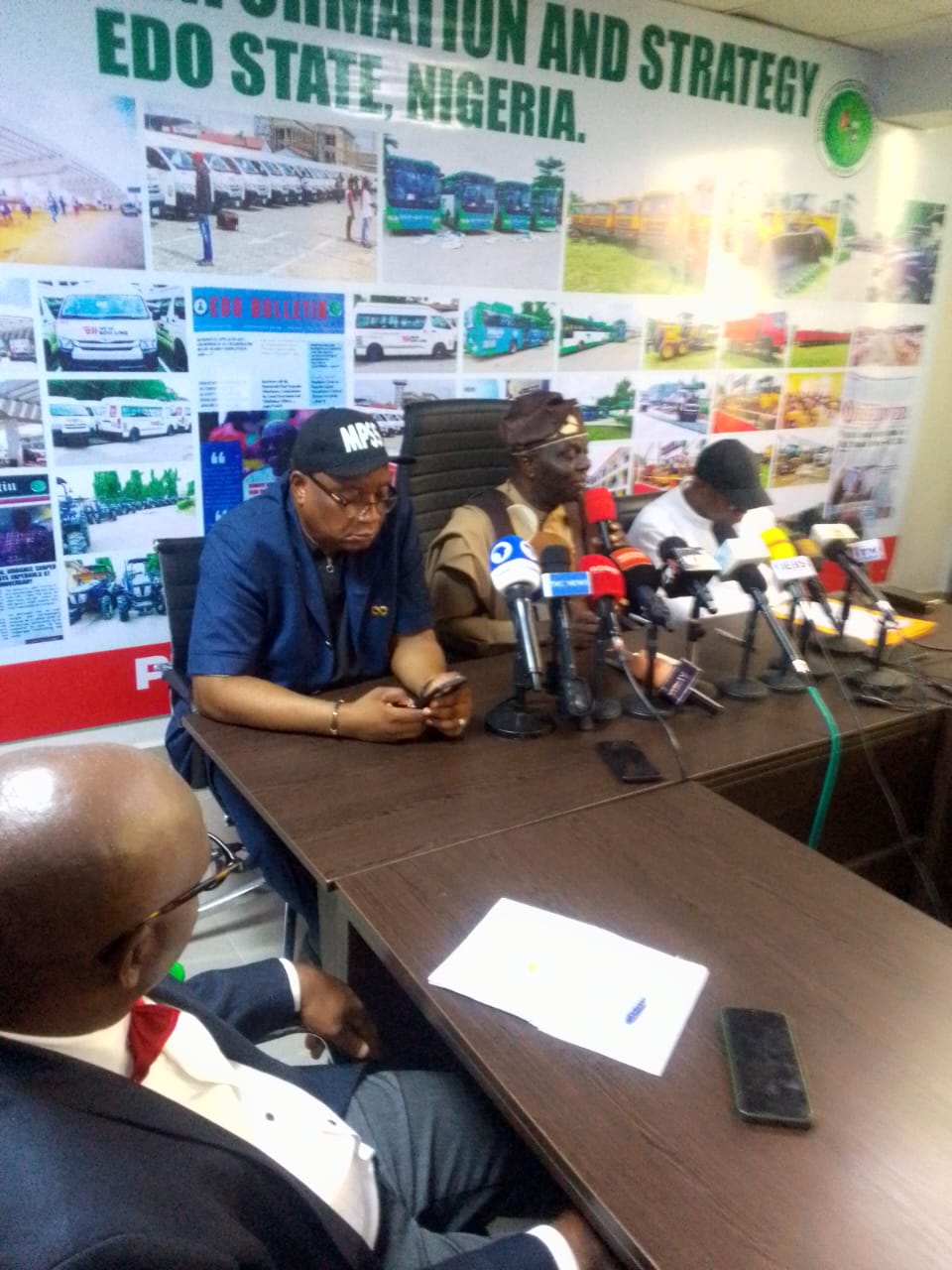
The Commissioner for Information and Orientation, Kassim Afegbua, stated this during a press briefing in Benin City, where the Commissioner for Transportation, Hon. Saturday Uwuilekhue and Commissioner for Public Safety and Security, Hon. Festus Ebea highlighted ongoing reforms and policy initiatives of the Governor Monday Okpebholo administration.
Afegbua described claims that teachers were being owed salaries as false and misleading, stressing that salary payments remain a top priority of the government.
“Let it be on record today that Edo State Government is not owing any teacher,” he declared.
“I have read a couple of statements credited to some people that teachers are being owed. Salaries and other emoluments occupy the first line charge of the Governor Okpebholo administration.”
He explained that where an individual worker may not have received salary, the circumstances surrounding such cases should be investigated rather than generalized as government indebtedness.
“If any particular individual, maybe a teacher or any other government worker, is not being paid, you have to find out why he or she is not paid, not for people to carry reports that teachers are being owed,” Afegbua said.
The commissioner further highlighted the administration’s employment record, noting that thousands of workers have been absorbed into the state workforce since Governor Okpebholo assumed office.
“Since Okpebholo assumed office as governor, we have employed over 5,000 teachers who were kept as casuals by the last administration. We have also employed about 2,000 health workers, we have also employed 2,500 Edo Security Network personnel and all their salaries are taken care of,” he said.
He accused those spreading contrary information of attempting to tarnish the image of the government.
“So when you see people going about to say we’re owing teachers, they’re deliberately misinforming the public. They want to give us a bad name so that they hang us,” Afegbua added.
Also addressing journalists, the Commissioner for Transportation, Hon. Saturday Uwuilekhue, reiterated that the restriction on motorcycles and tricycles within Benin metropolis remains in force as part of measures aimed at improving traffic management and safety.
“The restriction of motorcycles and tricycles to suburb areas and earth roads remains in force. Consequently, these two-wheel and three-wheel vehicles are prohibited from operating on city highways and other restricted roads within the metropolis,” he stated.
Uwuilekhue said the ministry remains committed to developing “a safe, efficient, organized, and modern transportation system that supports economic growth and enhances the quality of life of our citizens.”
He also announced the continued enforcement of the ban on unpainted commercial vehicles operating within the state.
“The first is the ban on the use of unpainted commercial vehicles within Edo State. This policy was introduced to ensure uniformity, proper identification, and regulation of commercial transport operators,” he said.
To strengthen regulation and improve security, the commissioner disclosed that the ministry had commenced profiling commercial transport operators across the state.
“The Ministry has also commenced the profiling of commercial vehicles operating within the State. This exercise is aimed at creating a comprehensive database of commercial transport operators for planning, security, and regulatory purposes,” he said.
He added that security identification numbers would be issued to operators and displayed prominently on vehicles.
“As part of the exercise, security identification numbers will be issued and displayed on taxi roof signs and bus roof signs to enhance passenger safety and facilitate easy identification of operators,” Uwuilekhue explained.
The commissioner warned commercial drivers against indiscriminate parking and passenger loading on major roads, saying such practices contribute significantly to traffic congestion.
“Commercial vehicle drivers are prohibited from unauthorized parking, loading, and discharging of passengers along major transport corridors and at locations not designated for such activities. This measure is intended to improve traffic flow and reduce congestion within the metropolis,” he said.
He further announced restrictions on the loading and offloading of goods by heavy-duty vehicles between 7 a.m. and 6 p.m. along major roads and market corridors, including Forestry Road, Mission Road, Oba Market, Ekiosa Market, Ramat Park, Aduwawa Market, Oka Market and Uselu Market.
Other transportation regulations being enforced by the ministry include the prohibition of abandoned broken-down vehicles on public roads, repairs on highways, the use of roads for social ceremonies that obstruct traffic, and the use of road shoulders as motor parks.
Uwuilekhue also revealed that the ministry is pursuing several Public-Private Partnership initiatives aimed at modernizing transportation infrastructure and services in the state.
Among the projects are partnerships with Fulfil Africa to revitalize Edo Courier Services through New Edo Line, Saggiton Investments Limited for the development of a modern parking facility in New Benin, and Upland Realtors for the establishment of a truck transit park.
He further disclosed that discussions were ongoing with investors to introduce Edo Ride, a technology-driven ride-hailing and intra-city transport service.
“Furthermore, the Ministry is engaging other private investors to introduce Edo Ride, a modern ride-hailing and intra-city transportation service that will improve mobility, create employment opportunities, and provide residents with safe, reliable, and technology-driven transport services,” he said.
The commissioner called on transport operators and residents to comply with all transportation regulations, emphasizing that the reforms were designed to promote safety, security, efficiency and orderliness in the sector.
“Together, we can build a transportation system that meets global standards and supports the economic aspirations of Edo State,” he said.